Wilson Electronics Makes Cell Calls More Reliable

Brian Allread is a senior manager with Wilson Electronics.Consider this scenario: your high-net-worth client, for whom no expense is ever spared, hears his cell phone ring and immediately runs outside to answer it in the only place where he can get a decent signal. In these situations, the cell signal outside is at least adequate, but the signal inside is poor to non-existent, usually due to the distance from the cellular tower, regional terrain issues, or building materials like brick, stone, concrete, metal or steel, all of which block signals from getting inside. That’s where Wilson Electronics’ cell booster comes in. It captures the cell signal from outside, amplifies it, and then re-transmits the now-boosted signal throughout the home or building. The result is a strong, reliable signal inside that can be used by multiple voice and data users simultaneously, regardless of which cellular service provider they have. To learn more about this product, RS interviewed Brian Allred, one of Wilson’s senior managers.
Does your product require special training and tools from a professional integrator?
Wilson makes a few DIY booster models, but they’re typically used to provide signal coverage for only a few rooms or an area smaller than a house. On the other hand, Wilson has more than 10 models that have been developed specifically for professional installation and designed to cover entire homes or large buildings. These boosters and related components require skills usually associated with professional integrators, like roof mounting of antennas, pulling cable, and adjusting the booster to provide optimal coverage.
Do you have a certified installer program?
Yes. The program is brand new and still in testing. We plan to roll it out for all interested installers at CEDIA.
What kinds of cellular devices will your boosters support?
Wilson boosters support any device that uses North American cellular frequencies for voice or data communication. So that means cell phones, data devices like cellular modems and data cards, and cellular-enabled tablets and internet hotspots like Novatel’s MiFi.
Do all boosters on the market support all carriers?
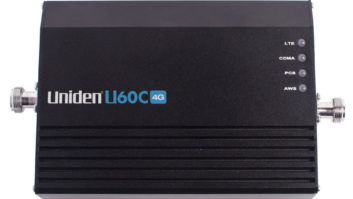
Wilson Electronics’ AG Pro-Quint Five-Band 4G-3G Indoor Cellular Signal Booster was introduced at the recent CTIA show. Each installation also requires an exterior antenna (inset).No they don’t. Some boosters support only devices operating on a specific carrier’s network. While there are exceptions, Wilson boosters by and large support devices operating on all carriers’ networks. The current exceptions are 4G boosters. Wilson has manufactured boosters that will boost Verizon’s 4G LTE on its 700 MHz band and a booster that will amplify the AWS band. Both can be used in conjunction with other boosters that will work for all 2G and 3G networks. Additional boosters that will support multiple bands, including 2G, 3G, and 4G, should be available later in 2012.
Do boosters require any special permits or licenses to own or install?
No. The Federal Communications Commission has recognized that in many areas signal boosters are needed to provide consumers with reliable access to cellular service. In addition, Wilson has worked closely with Canadian cell carriers to design boosters that ensure their customers in remote areas have reliable service. Wilson boosters can be installed in all 50 U.S. states and all Canadian provinces without special license or permit.
What’s the value proposition and go-to-market strategy for your products?
Wilson installers/resellers can make up to 40-percent margin on product sales, plus an installation fee on top of that. This can be an excellent source for additional revenue, especially since a Wilson booster system is not a difficult installation for professional installers. A Wilson booster is a great add-on sale when an installer is already in the customer’s home doing another installation and is able to quickly notice if the customer has poor cellular signal and can offer a booster solution to fix that problem. Wilson products are sold through multiple distribution channels, as well as dealer direct.