“I used a lot of solder when I was kid,” said Brian McAuliff, in describing himself as a longtime electrical hobbyist.

This media room features a subtle integration of technology into the brick fireplace that can be enjoyed from the open kitchen space.
McAuliff, the president of Bri-Tech, an electronics systems contractor in Bohemia, NY, started out building heathkits after his uncle gave him some test equipment, initially working out of his home and transitioning into an electrical contracting firm. As the young contractor got into more complex electronics, “clients asked us to do things in their homes,” he said. “That’s how we grew.”
Since making that progression, the electronics side of McAuliff’s business has been three times larger than the electrical contracting business.
McAuliff has developed a unique understanding of the ESC business from watching it evolve over the years. This perspective has helped him transform his business into a brand name in high-end integration.
The current breadth of work for Bri-Tech includes as many technologies as possible, including security, shading, and gate control all wrapped into one system with the capability to do a lot more. The 21-year firm currently employs 35 people between its original location on Long Island and a satellite office in Greenwich, CT.
Bri-Tech’s business today is split about 40/60 between residential and commercial installations, and as most electronic systems contractors have experienced over the past few years, its midlevel $30,000 to $40,000 jobs have virtually disappeared. Yet Bri-Tech has continued to earn high-end $200,000 installs to keep itself busy. “We give a lot of value to high-end systems,” McAuliff noted.
Brian McAuliff, president of Bri-Tech
One way that Bri-Tech provides this high value is by taking system reliability very seriously. This attitude stems from one of McAuliff’s early influences working in a failure analysis job early in his career. “When you’re networking 200-300 processor-based components into one system, you can’t afford a problem or a third-rate supplier without tech support 24/7.”
McAuliff, therefore, bases most of his buying decisions on product reliability, rather than a simple fascination with every new widget that comes along. In this respect, he hasn’t always followed the hottest new trends, which he admitted sometimes works to his advantage, yet sometimes does not. He was initially against iPods and tablets because he is an audiophile, for instance. That attitude had to change, of course. “All our systems are fully integrated with mobile now, and I love them,” he said.
In terms of reliability, McAuliff has been really careful with the vendors he chooses to do business with, selecting such partners as Crestron, Lutron, and SIM2. He cited the support that these brands provide him as the top reason for his loyalty to them. Bri-Tech also tests new products extensively before recommending them for clients.
This dedication to the highest quality service and standards led McAuliff to develop a unique, in-house software system, called Symbiant Automation. A former customer that had worked as a high-level programmer for one of the top business software companies in the world engineered Symbiant for Bri-Tech. “For three years, we put him off in a corner to write the software professionally,” McAuliff explained.
The result was a very organized, welldocumented home automation control system that uses Crestron touchscreens and controllers. “Our software code is written like an encyclopedia,” he said. And the intention was for all Bri-Tech controls to have “depth of control,” since many clients end up limited by software complexity.
Symbiant Automation allows clients to adjust source volume, bass, and treble. Clients can drill down to each component to make personalized adjustments. Although not every client chooses to make these adjustments, they have that option without the necessity of programming know-how.
McAuliff has attempted various direct marketing efforts over the years, but he found that as soon as he stopped doing so and turned that attention to further quality-control initiatives, “that’s when we grew,” he said. Bri-Tech experienced this growth in the worst economy, simply from word of mouth. The key behind this thinking is a no-brainer: “make sure our stuff works.”
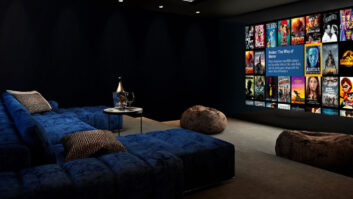
(Above) The current breadth of Bri-Tech’s work includes as many technologies as possible, which in this case include custom LED lighting over a bar integrated with a dedicated theatre room.
(Below) Bri-Tech often integrates technology very discretely, yet impressive in scope and functionality. Pictured here is the sunroom of an estate on the north shore of Long Island.
With this attention to quality firmly established, McAuliff makes sure to charge enough for Bri- Tech’s services to not only walk away with a profit, but to enable the company to invest in talent and expertise. “You can’t just buy a guitar and play it. And this is like an orchestra,” he said of the advanced systems his company installs.
Bri-Tech designs technology that is very discrete, yet impressive in scope and functionality. The company also stands behind the practice of not issuing bill of materials to clients. Each system installed is based off of a client-designated budget. Bri-Tech performs a “posh” presentation of proposals using its own paperwork and brochures and presents the firm as a brand within a brand by using the Symbiant Automation logos with subsequent manufacturer logos. By avoiding a bill of materials presentation, clients don’t have the opportunity to become overly fixated on small elements of the project, and they are left to fully trust and depend on Bri-Tech’s expertise.
One of Bri-Tech’s recent projects was for a penthouse apartment in Trump World Tower at the United Nations Plaza in New York City. The installation included a dedicated home theater and fully integrated automation system. Bri-Tech integrated Crestron DigitalMedia HD connectivity and AV switching, as well as an ADMS Intermedia Delivery System. Twelve wall-mounted touchpanels, four handheld Wi-Fi touchpanels, and three iPads control 10 HD video monitors, the ADMS, 72 lighting zones, six climate control zones, 15 rooms with dual motorized shades, 300 feet of LED lighting, an eight-camera surveillance system, and a player piano system. Music is distributed through a 16-zone entertainment system capable of IP radio and featuring multiple iPod docks.
Bri-Tech recently finished a lakefront country home on the south shore of Long Island. The residence has two street entrances and a back alley, having originally been designed as an estate in the 1920s. Bri-Tech furnished the property with a dedicated theater and billiard room featuring two screens and motorized brackets over the fireplaces. A great deal of attention was paid to matching security cameras to the house’s moldings and creating custom faceplates.
One light commercial project Bri-Tech is currently working on is the Parrish Art Museum in the Hamptons. Advanced security, Crestron lighting control, video surveillance, integrated AV, as well as networking and communications are all part of the plan. When completed, the museum will be one of the most technologically advanced buildings on the east end of Long Island. “When we build this museum out, we’re over building it,” McAuliff said. “We’re putting this together meticulously. That’s what makes us special.”
Lindsey Adler is associate editor for Residential Systems and Systems Contractor News.