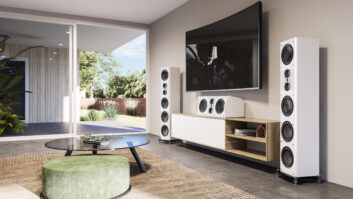
Affordable cone-and-dome speakers give me anxiety, and not in that irrational Billy-Bob-Thornton-antique-furniture-phobia kind of way, or like my best friend’s intense fear of frogs. No, it’s more like, at this point, what’s left to say about mid-priced cones and domes? Throw me a funky folded tweeter or line source, and I’ve got something to wax about. But drop what appears to be a pretty standard speaker on my front stoop, and I’m probably going to let it sit in the box for a while to taunt me with its ordinariness until my deadline is nipping at my heels.
And I would imagine that you, as an integrator, feel the same way. There’s a certain demographic to which a $20,000 loudspeaker just kind of sells itself, doesn’t it? It’s $20K. It must be awesome. But in the more affordable sub-$2,000-per-system territory, it’s tougher to stand out. Some do it with the aforementioned exotic driver technology. Some do it with ludicrous marketing budgets. But how do you and I make what on paper looks like a fairly regular, affordable speaker sound exciting?

The marketing copy for Paradigm’s new hotoff- the-presses Cinema 100, 200, and Sub speakers don’t help much, with such blistering language as “upgraded crossovers” and “technology borrowed from the Reference Signature series.” I’m convinced that such understatement is a clever ruse, though. One can’t help but take in the sum total of the new Cinema speakers’ presentation–as sexy as they are–and think, with a hint of ennui, “Sure they’ll sound good. They’re Paradigm. But ho hum.”
And then you hear them…
Well, no, actually–first you install them. This is a process that Paradigm has made as simple as possible by including just about every mount and stand option that you could want. The Cinema 200 comes with both on-wall mounting brackets and a kickstand that screws onto the back of the speaker, the latter for horizontal center-channel use only. As a main left or right channel, wall mounting is pretty much your only option, but the proprietary bracket is simple enough, and provides an ample center hole for bringing speaker cable out of the wall and into the speaker. Tolerances are tight, but if you can get everything wired up (a weensy bit tricky due to the recessed binding posts) and mounted without breaking your foot (long story), it makes for a flush fit that really complements the clean elegance of the 200’s design.
The Cinema 100 is a little more flexible in terms of mounting options. It comes with a stand for use as a bookshelf (either horizontally or vertically configured) as well as a proprietary wall mount that allows for a good bit of aiming if you have to place the speaker a little high or too far back. You’ll need to provide a couple of screws if you go with the wall-mount options, but other than that, the box includes everything you’ll need to get the speakers situated.
And THEN you hear them.
And the first thing you can’t help but notice is how incredibly dynamic they are. Even if you’ve heard a multitude of speakers in this size and price range that sound surprisingly good (and there are plenty), try to find another speaker system in this class that sounds so yummy across such a wide volume range and you’ve got your work cut out for you. The subtlest of sounds sashay into the listening space with a subtle confidence that’s impossible not to love. I’m hard pressed to think of another speaker I’ve heard of this size that sounds so wonderful at such low volumes.
Lean on the volume a little harder, though, and you never really hit that spot where they “open up,” so to speak. That’s because they really don’t need to. From whisper-quiet to downright raucous, the 100s and especially the 200s exhibit the sort of wonderfully consistent, open, neutral frequency response you’d expect from much larger, much pricier speakers, with no significant loss of detail at low volumes and no real loss of clarity even far past the point where your four-legged family members are evacuating the room.
And then there’s the Cinema Sub–a bit of an oddity from Paradigm in that it actually looks like a subwoofer. As with the rest of the Cinema system, it’s a coy little thing, boasting a modest 300 watts of dynamic peak power (100 watts RMS) for its eight-inch driver, whereas other manufacturers seem content to tout 1,000 watts or more at the same size. Don’t let the numbers fool you. Even though it doesn’t try to extend to the deepest of subsonic depths, the little Cinema Sub fills my mid-sized secondary listening room handily, and I’m not merely talking about loudness. This is the first sub of its size that I’ve had in this room in the history of ever that didn’t leave me wanting for a second sub just to even the sound out a bit.
Combine the Cinema Sub with three Cinema 200s and a pair (or quartet) of Cinema 100s (or a full set of 100s for smaller rooms), throw in an Anthem MRX receiver, and you’ve got the makings of a truly audiophile system that sounds as sumptuous with stereo material as with surround music and movies, all for less than 35-hundred bucks.
905.564.1994
www.paradigm.com
Kudos
Paradigm’s newly updated Cinema series speakers boast the sort of dynamics that you just don’t expect at this size and price point.
Concerns
While the spring-loaded, recessed binding posts of the Cinema 200 make it much easier to flush mount the speaker, feeding those posts with stranded speaker wire any thicker than 16 gauge can be tricky, to say the least.
Product Specs
• Cinema 200:
• Crossover: 2nd-order electro-acoustic at 1.8 kHz
• High-Frequency Driver: 25-mm (1 in) S-PAL dome tweeter, ferro-fluid damped and cooled
• Bass/Midrange Drivers: Two 102-mm (4 in) mineral-filled polypropylene cones, 25-mm (1 in) hightemperature voice coils, advanced motor structures with oversized ferrite magnets