Kudos: Gorgeous, truly unique design and appearance; exquisite craftsmanship; warm, open, and detailed sound
Concerns: Pricey; a tad bass shy; light reflections
Chanel. Givenchy. Cartier. Hermes. These French houses are instantly recognizable as global icons of style and luxury fashion.
Louis Roederer’s Cristal. Château Haut‑Brion. Château Pétrus. Château Lafite Rothschild. These French winemakers are prized among oenophiles and widely considered the pinnacle of winemaking craft.
Trinnov Audio. Storm Audio. L-Acoustics. Focal. Devialet. These companies will be more familiar to Residential Systems readers, and are all French companies pushing the boundaries of high-end home audio and theater sound.
Point is, for years, France has been a manufacturing hub for some of the finest luxury products in the world, and they have not-so-quietly become a force in making some of the most premium products in our industry.
To that list of prestigious manufacturers, add Waterfall Audio, whose products are designed and fully assembled in the company’s workshops in the Provence Alpes Côte d’Azur region, in the village of Carcès in southeastern France. Or, as the company likes to say, “Manufactured in France in pure French luxury tradition, famous the world over.”
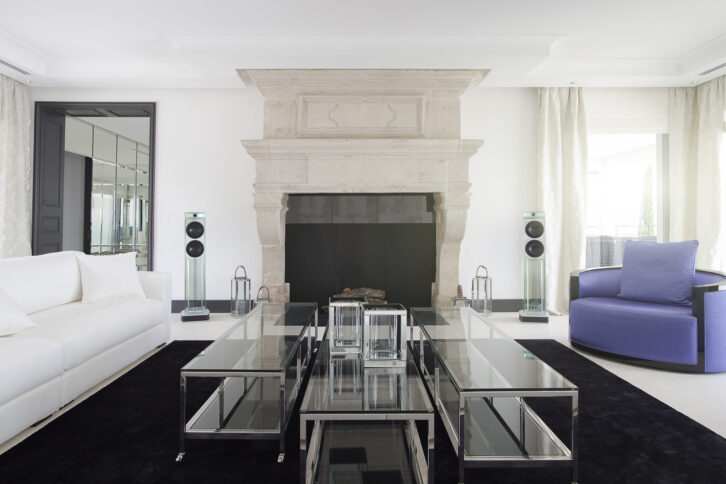
“Unique” is a word that is often bandied about, but by definition, it means “being the only one of its kind; unlike anything else,” and that is the only word that accurately defines Waterfall Audio’s designs, which are truly unlike any other speakers you’ve ever seen. They also might be the perfect solution for the demanding client seeking both high performance and exquisite style and design.
While the company has a full lineup of speakers, including floorstanding towers, in-wall, on-wall, and even subwoofers, this review focuses on Waterfall’s new Niagara XT3, the pinnacle of the company’s truly unique, all-glass loudspeaker lineup. Yes. A loudspeaker with a cabinet made entirely of 10mm thick platinum safety glass, making for a stunning look that becomes a statement art piece all on its own.
Waterfall Audio’s History
Waterfall Audio might be a name new to you — I actually discovered them about 10 years ago, wandering a hallway at the Venetian during CES. This all-glass speaker literally stopped me in my tracks. The company may have a low profile in the U.S., but it has been around since 1996, with its first speaker debuting in 2000.
Company founder and CEO Cedric Aubriot is a lifelong audiophile who built his first driver at age 10 and never stopped chasing better performance. He knew traditional, braced wood cabinets could sound great, but he wanted to create something “sexy and different and niche” with a higher spousal approval factor.
That search eventually led him to glass.
With loudspeakers, it’s the driver movement not the cabinet vibration that produces sound. In fact, cabinet vibration introduces distortion, coloring the audio in ways you don’t want. Glass, besides being visually striking, is extremely dense, so cabinet vibration doesn’t influence the sound. Remove that box coloration and you’re left with the foundation for a very neutral, natural-sounding speaker.
Of course, designing a speaker out of glass brings its own challenges. Because glass is dense, hard, and reflective, Waterfall needed a new way to dampen driver energy and control internal reflections. Traditional foam stuffing, the usual solution, wasn’t an option as it would be visible inside the transparent cabinet and ruin the aesthetic. (Aubriot noted that some companies solve this by filling panels with sand, because of its density and inertia. And glass is sand.)
Waterfall’s solution was ADT (Acoustic Damping Tube), a technology the company patented 25 years ago. By placing the damping chamber directly behind the driver, they could muffle energy at the source and control reflections without compromising the visual impact of the all-glass design.
That design has now evolved into the company’s latest iteration, Jetstream Technology, named for its turbine blade appearance that adds another visual flourish. Jetstream further limits the return of the back wave, improves mid- and high-frequency damping, optimizes air flow pressure for better bass, enhances heat dissipation, and mechanically uncouples the mid bass drivers from the glass structure. All speakers with an “XT” designation include this upgrade.
Since the beginning, Waterfall Audio has partnered with driver manufacturer Thierry Comte of Atohm. This is a 30-year-long relationship, and all Waterfall speakers feature Atohm drivers, which are also manufactured in France. Atohm also designs and supplies Waterfall’s RS700 amplifier, used in this review.
One of the company’s oldest models, the Victoria, is now in its fourth generation and has been around for nearly 30 years. Aubriot compares it to the Porsche 911; a design that evolves over decades yet retains its iconic, recognizable shape. He notes that until the recent XT redesign incorporating Jetstream, “the previous Victoria lasted 17 years without changing a screw.”
First Impressions
The first time I realized speakers could be a design element in a room was back when I was a golf professional. A member invited me over for dinner, and he had an Andy Warhol original centered on a wall, flanked by a pair of large Martin Logan towers. The speakers weren’t hiding in the room; they were defining it.
That memory returned when I removed the Niagara XT3s from their packaging. (Technically, my first impression happened pre-unboxing when I noticed the serial numbers of my review samples: 0003 and 0004. Rarefied company indeed.)
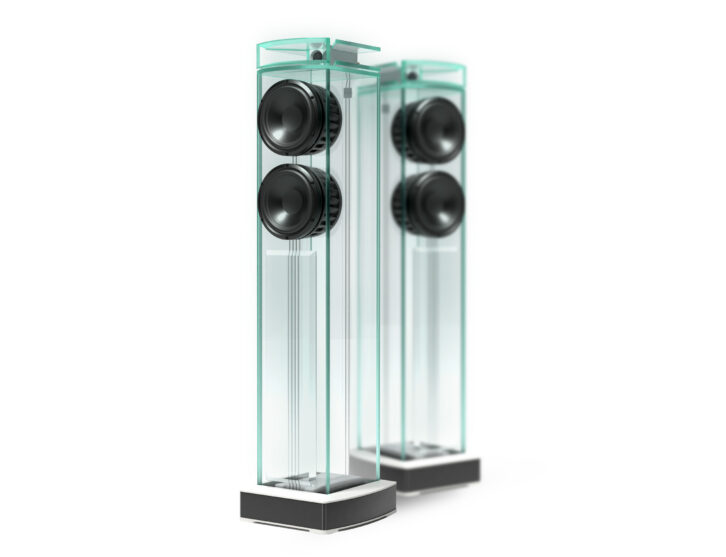
The XT3s resemble speakers in the sense that they’re tall and rectangular with two black 7-inch mid-bass drivers high up front. You see them and know what they are, yet at the same time, they more resemble a sculpture or modernist art installation reinterpreting the idea of a loudspeaker.
The XT3’s meticulous construction elevates fit and finish to the next level. Aubriot claims 0.1mm precision on the glass assembly, with machining tolerances of ±100 microns, using tools costing millions of Euros and relying on some of the most sophisticated glass-making processes available. The result is visually stunning and a testament to Waterfall’s craftsmanship.
The 10mm safety glass is thick, heavy, and solid, yet beautifully transparent, with a subtle greenish tint where the edges meet. Platinum glass, a modern finish combining glass and platinum, adds clarity and elegance, letting you see into and through the speaker and giving the illusion that the drivers are floating in space, with requisite speaker wiring tracing symmetrically up the front and rear panels.
Equally unique to Waterfall’s Niagara series is the glass horn tweeter, which Aubriot describes as a “masterpiece on its own, defying cutting and assembly techniques.” It arrives packed separately, nestled inside the main carton, and sits atop the tower on rubber bumpers, physically decoupled. It becomes its own small piece of glass art that also happens to be the high-frequency driver.
Aubriot has long admired JBL’s professional series, and the horn tweeter draws inspiration from the iconic JBL 2397. It took two years to develop and served as the catalyst for pushing performance into a higher tier while offering a more luxurious product. The structure consists of 11 mechanical glass parts requiring more than four hours of machining and another four hours of hand assembly, “following the same techniques used in luxury jewelry factories.” From the top down, the final cut echoes the “W” for Waterfall. The only part that feels slightly “less than” are the thin (18 gauge?) wires connecting the horn tweeter to the speaker.
There’s a large rectangular glass section on the lower front of the speaker, and I asked whether it served any acoustic purpose. Waterfall’s co-founder and export manager, Nadine Aubriot, explained: “The over piece of glass is mainly for cosmetic reasons, and if you notice, the beveled edges add beauty when sunlight is caught and looks like a rainbow in the room. At CES, I always chose a room with western exposure where the sunset would give a magic look, a real ‘Wow!’ effect with the speakers coming alive. From a technical point of view, it adds rigidity and shows off our craftsmanship because that front panel is filled with our special glue in a perfect, totally clear way.”
Adding to the XT3’s dramatic appearance — while also providing structural support for the glass tower and housing the crossover components and 8.25-inch passive bass driver — is the base. It’s machined from a single block of aluminum, gently tapered and beveled, then wrapped in hand-stitched premium Nappa leather. The white stitching on deep gray leather evokes the interior of a luxury sports car, showing attention to detail down to the last millimeter and looking elegant from any angle.
The bottom rear of the tower and the rear of the tweeter both feature large, premium 5-way binding posts for connection to the amplifier.
For those looking for a different aesthetic — or who want to shave $14,000 off the XT3’s $52,500 price — Waterfall offers the XT2. It’s identical in performance, size, and driver configuration, but uses a machined solid-wood block instead of glass for the horn tweeter enclosure. Wood is significantly less expensive to manufacture and was requested by customers wanting a warmer material. And thanks to natural variations in wood grain, species, and finish, each XT2 pair is truly one of a kind.
In my humble living room, the XT3s were undeniably beautiful. As Nadine Aubriot mentioned, there were times of day when they created magical rainbow prisms as sunlight hit them just right. And thanks to the solid, heavy base, they felt sturdy; definitely not delicate flowers you need to tiptoe around or fret whenever someone approaches them.
But they also clearly outclassed the rest of my décor, a Baccarat crystal flute of Dom Perignon at a hamburger diner. (I mean, a nice diner, but still…)
These speakers belong in a Manhattan penthouse overlooking the skyline, or in a minimalist artistic space in Laguna or Miami with floor-to-ceiling glass walls and an ocean view. They should be surrounded by other objets d’art, not sitting next to a Roomba.
Review: Stealth Acoustics LineaRadiance 430 Invisible Speakers
But did my wife think they were beautiful? Abso-frickin’-lutely.
Fortunately, for those who love the Niagara aesthetic but not the Niagara price, Waterfall offers the Victoria XT at $8400 — about 16% of the XT3’s cost. It retains much of the design language, but uses slightly thinner, 6mm glass, smaller drivers, and a more traditional (and far less expensive) soft-dome tweeter, making it more attainable.
Setup
I placed the XT3s in my living room in the spots typically occupied by my SVS Ultra Evolution Pinnacle towers. For power, Waterfall Audio sent its RS700 Special Edition amplifier that delivers 700 watts peak per channel in a dual-mono configuration, which I wired to my Trinnov Altitude 16 via XLR cables.
To complete a surround experience, Waterfall also sent three of its Elora Evo Center speakers with optional aluminum tabletop stands. I used one as the center with the XT3 and installed the other two in a separate room horizontally as a left/right pair. (Waterfall does offer an Evo LR, which is designed for vertical orientation.)
Waterfall realized it needed a compact stand or even a wall-mount option in the lineup, which led to the Elora Evo. Visually, the Evo definitely echoes the family design. It is a three-driver design with dual 4-inch mid-bass and a 1.75-inch silk-dome tweeter in a D’Appolito array, machined out of a solid block of aluminum and then flanked by thick sheets of the platinum safety glass. However, the glass here is for aesthetic reasons rather than performance.
Compared to the visual scale of the towers, the Elora center looks a bit dinky, though in practice, it reproduced dialog clearly and didn’t have any trouble reproducing the weight of male vocals, even though it is rated down to just 120 Hz. To be fair, the Trinnov routed bass info to my subwoofers. However, the Evo’s bass performance limitations were definitely clear when listening to the pair in 2-channel, where their inability to deliver those bottom octaves was apparent. Waterfall suggests using them with a subwoofer in that application, and I’d wholeheartedly agree. I also wasn’t distracted by any serious tonal shifts as sound panned across the front LCR channels.
When listening to the XT3s in stereo, I disabled the Trinnov’s Optimizer processing and any bass management, running them full range.
Performance
Regardless of how good they look, a speaker’s raison d’être is to reproduce audio, and at some point, people are going to stop looking and start listening.
Throughout my listening, the adjectives that kept coming back to mind to describe the XT3s were “smooth” and “detailed.” Like warm melted butter oozing into the room, audio was neutral and laid back, never forward or exaggerated. The horn tweeter is open and airy, producing detailed and textured highs, but always with that layer of smooth warmth beneath. I also enjoyed that speakers produced plenty of detail, especially in the higher frequencies, even at lower volumes. These are not speakers you have to crank to enjoy.
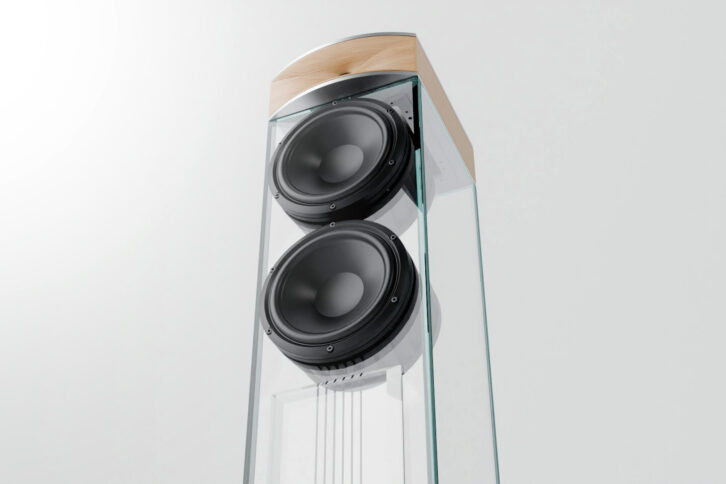
While the low end is present, these are not bass-heavy speakers. Rated to 35 Hz, bass is there, but if you listen to a lot of bassy material — or plan to incorporate them into a theater environment — you’ll definitely want to add in a fast and capable subwoofer, especially if you are looking for a more tactile experience. Also, bass performance was something that required a bit more volume to appreciate.
Hans Zimmer’s “Beginnings are Such Delicate Times” from the opening of Dune: Part Two was the perfect vessel to show off the XT3’s strengths, with the swirling sands dancing effortlessly and sparkling back-and-forth across the front soundstage, giving the song a near-hypnotic, dreamy feel. The opening bass notes also revealed the edge of what the woofers could deliver.
The speakers deliver both width and spaciousness to the soundstage, plus a solid phantom center channel. Singers were always locked into a space centered between the towers, while enabling you to locate and identify the positioning of instruments across the soundstage, but sounds expanded beyond the width of the speakers themselves.
Where the XT3 really shone for me was with jazz content that features female vocals, delicate cymbal and brush strokes, and piano, which the speakers deliver with terrific detail and emotionality. If that description sounds like a recipe for Diana Krall, well, you’re mostly right, but I’m speaking of jazz chanteuse Laura Anglade. I discovered her during an episode of IT: Welcome to Derry, where she sings at the Black Spot, and then looked her up on Tidal. It also seemed apropos that Anglade was originally from the village of Brousse-le-Château in the south of France, and her latest album, Get Out of Town, plays right into the XT3’s wheelhouse, keeping her voice clear and delicate in the center as she reinterprets a variety of standards with the mostly simple arrangements happening around her. Great stuff!
Speaking of Krall, the XT3s keep her voice big, husky, and lush in the center of the room, along with a wonderful sense of space and ambience around it, with the drum kit set slightly left and behind her, and the crowd applause wide across the front wall throughout Live In Paris. Her “No Moon at All” from a high-res Tidal stream off Turn Up The Quiet begins with Krall on piano, then joined by John Clayton on the double bass with bass plucks that have such rich texture, you can feel his fingers on the strings.
I went up and touched the speakers while music was playing, and, even at high volumes, only the slightest vibration could be felt on the glass exterior, which was certainly a testament to the Jetstream technology. One thing that might be an issue is that in certain lighting conditions or angles, the platinum glass finish is so reflective that the speakers become almost mirror-like. Not really an issue with music listening, but certainly could be distracting with movie watching.
Waterfall Audio’s Niagara XT3 represents a truly unique proposition in the luxury speaker market, and in many ways feels like the culmination of everything France is known for: artistry, craftsmanship, and devotion to beauty. From the glass cabinet to drivers floating in space, to the jewel-like glass horn tweeter, the XT3 is equal parts artisanal glasswork and acoustic engineering. As such, it isn’t the speaker for every client, but rather something reserved for the most discerning and design-conscious; for those who appreciate design as much as performance.
The Niagara XT3 will be a statement piece in your showroom that will start conversations centered around design, beauty, style, and what is possible at the intersection of art and audio.
888-866-0007 phone – waterfallaudio.Com/En
Product Specs:
- Luxury 2.5-way floorstanding, all-glass tower speaker
- Entire cabinet crafted from 10mm platinum safety glass
- Speaker base manufactured from solid aluminum wrapped in premium stitched Nappa leather
- Features one 20mm Atohm SD20X + glass horn tweeter, two 180mm Atohm LD180 long excursion mid/bass drivers, and 210mm Atohm UFR210 low-frequency driver
- Rated 35 Hz–28 kHz (±3 dB) frequency response
- Nominal impedance: 8 ohms; 90 dB sensitivity; 40–250-watt recommended power (500 watts peak)
- Dual gold-plated 5-way speaker binding posts
Dimensions: 11.81 x 46.03 x 13.63 inches (WxHxD); Weight: 97 pounds