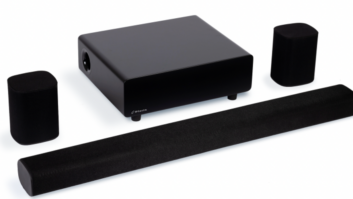
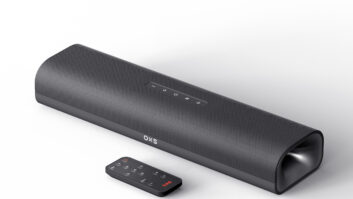
Until recently, the soundbar was the Rodney Dangerfield of the custom installation industry; they’d “get no respect.”

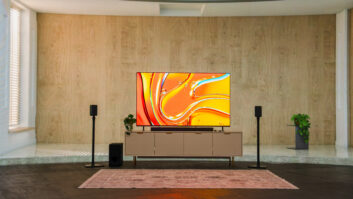
Leon Speakers actively strives to reposition the soundbar category perceptually, coining its own generic–“living-space theater speakers”–that company president Noah Kaplan said better reflects the environment they’re intended to be used in. This installation was performed by Creative Systems of Natick, MA and features Leon’s Horizon Hz414-X-A three-channel soundbar.
In a universe that has long decreed that L-C-R and surround arrays should be discrete, wired propositions, soundbars, and their DSP 5.1 legerdemain have seemed like DIY plug-and-play magic acts to many AV systems integrators, asserting stereo and even surround from a single unit.
The first soundbars aspired only to stereo; Polk Audio upped the game in 2005 by applying a stereo image-widening algorithm to create a surround effect for its SurroundBar. Philips did much the same when it applied the SonoWave DSP to a split-unit surround product with a phased array of three fullrange drivers in each, renaming it Ambisound. The concepts became continuously more sophisticated– Yamaha’s YSP-1 digital sound projector had both left and right drivers, as well as a phased array of 40 or so small center drivers. Other high-end units followed, including Definitive Technology’s Mythos XTR-SSA5, the Klipsch Gallery G-42, and the Polk Audio SurroundBar 500.
The soundbar is getting more respect these days. The category experienced a 250 percent sales jump in 2011 over the previous year, according to the CEA. Its popularity is being driven by the fact that as televisions get thinner, they are squeezing the life out of internal speakers. “It’s basic physics,” said Colin Clark, business unit manager at SnapAV, whose Episode brand just put its first soundbar on the market early this year. “As TVs get slimmer and slimmer, and as more consumers become aware of 5.1 and want their sound quality to match that of the HD picture, the soundbar becomes a very viable type of product. The soundbar fills the middle ground between the TV speakers and the [conventional speaker system].”
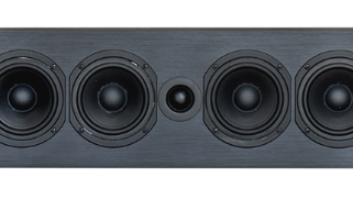
The first soundbar offering from SnapAV brand Episode is the 300 Series, 40-inch soundbar, released this year.
According to manufacturers, soundbars are not just a DIY consumer solution, but one that can augment a residential integrator’s home theater business. Many integrators were initially wary of the soundbar. Like the evolutionary path of many CE products, it went very quickly into an overseas mass-production model and quality and prices spiraled downward. That, however, was followed, atypically, by a resurgent phase that saw the introduction of progressively more sophisticated and expensive units. Leon Speakers’ Seven series, for instance, costs up to $22,500.
But the category’s earlier incarnation left a negative perception about them in many people’s minds. Ethan Kaplan, Leon’s marketing manager, stated, “We don’t like the term ‘soundbar,’ or to be known as [a] ‘soundbar company.’” Yet 80 percent of the company’s business comes from that category, with more than 50 models and configurations of them. Instead, the company actively strives to reposition the category perceptually, coining their own generic–“living-space theater speakers”–that company president Noah Kaplan said better reflects the environment they’re intended to be used in. “These are for television, not home theater projection systems,” he explained. “People listen to television differently than they do home theater, for instance, at much lower average volumes.” It’s a repositioning that has allowed Leon and a few others to make a market for a premium product in what had once been a solely big-box sector. “It’s something that integrators are leveraging, too,” he added.
Integrators Are Listening
Ryan Heringer, owner of integrator/dealer Sound Concepts in Jonesboro, AR, was reluctant to sell soundbars at first, but as televisions and their integrated speakers became progressively thinner and the sound suffered, he realized they could be a solid business proposition. “They’ve brought us more business than we might have lost” to direct-toconsumer sales at big-box stores, Heringer said. “We don’t sell a television now without a soundbar if the installation won’t have in-ceiling speakers. Too many customers complain about the sound of the television speakers. The soundbar is a great solution.”
Like Definitive Technology’s entire Mythos Series, its XTR-SSA models are fabricated from aircraft- grade extruded aluminum styled to perfectly match today’s ultra-shallow flat-panel TVs.
It’s also a good upsell opportunity. Heringer starts with the $399 Energy Powerbar as his entrylevel offering, which has an integrated amplifier, but he said most clients agree to move up to the $699 Klipsch G42 with a SnapAV wireless subwoofer kit, and some go all the way to the $2,000-plus B&W Panorama. At a time when the razor-thin margins on virtually all flat-screen televisions are eaten up by the credit card fee, the upmarket soundbar offers profit potential in the process of rectifying the selfinflicted wound that television makers have induced with thinner speakers.
Heringer said that the putative DIY allure of the soundbar quickly dissipates when many consumers discover that installing them isn’t as simple as it might have seemed. “We’ll often see someone call us after they’ve bought a soundbar at Sam’s Club and can’t get it on the wall just right,” he said. “We tell them to take their receipt and take it back to the store–we’ll sell them one at a similar price but with better performance and we’ll make sure it looks and sounds right. It’s not eroding our business; it’s adding to it.”
Customization Pays Off
Jason Turunen, owner of Theater X in Scottsdale, AZ, said the soundbar is also the perfect solution for the thousands of newly constructed condo units that have sprouted in the Southwest recently where building codes and community agreements limit or prohibit the use of in-wall and in-ceiling speakers. He uses Leon Speakers and Artison soundbars and said customers have high esthetic expectations for them, preferring that they look as though they were an extension of the television itself. That offers another chance to increase the margins by using the custom sizes and finishes that Leon soundbars offer, or the custom-sized grills from Artison.
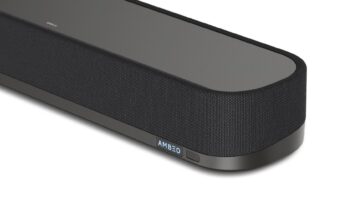
Polk Audio upped the soundbar game in 2005 by applying a stereo image-widening algorithm to create a surround effect for its SurroundBar.
“Leon will build the soundbar absolutely any way that you ask them to. You can ask them to build it 100 inches long and make the finish a shiny purple color with flashing LEDs and they will do it,” he said.
In fact, Turunen said, even some clients that can use in-wall speakers are opting instead to use soundbars because the industrial design has become attractive. And they’ve helped foster a small boom in second and third theaters in the same home.
Next Stop: Fully Wireless Solutions
The soundbar is also proving to be a launch pad for more innovations. For instance, Artison’s LCDRM takes the notion of a typical L-C-R array and instead, uses a pair of speakers located on the ends of the bar to create a center channel, one that company CEO Cary Christie said produces a more realistic center-channel effect for speakers located above or below the picture.
Al Baron, product line manager for Polk Audio, which was an early entrant in the category in 2002, pointed out other trends that make the category unique, including the fact that even as consumeroriented soundbar prices continue to decline–some Asian off-brands sell powered bars for as little as $79 retail. Prices for high-end units regularly cross the $1,000 threshold. Also, Polk research shows that while up to 90 percent of soundbars installed by AV integrators are wall mounted, the exact opposite is the case with soundbars purchased by consumers, who tend to put them on the same furniture as the LCD itself.
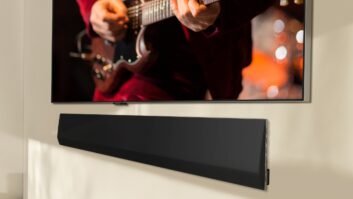
APW Custom Home Theatres of Canada performed this installation featuring Leon’s HzUT-LCR ultra-thin three-channel soundbar. Courtesy Steve Pomerleau Photography.
Baron noted, “[Soundbars are] one of those rare magic dichotomies in home electronics.”
Dan Daley is a freelance writer in Nashville, TN.
Wireless Audio Makes Waves
Until now, soundbars have been divided into two categories: passive and active, with the latter having a receiver integrated into the soundbar. What wireless functionality there is generally connects the subwoofer. The recently formed Wireless Speaker and Audio Association (WiSA) said a number of its members intend to change that.
The trade group’s big picture is predicated on moving wireless speakers to the 24-channel 5.1-to-5.8-GHz band, from the more limited 2.4-GHz band many CE products operate in. The system would then rely on a master box that detects all speakers plugged into power within a 10-meter by 10-meter space and determines each one’s distance from one another, automatically performing necessary delay calibration.
Applying this concept to wireless soundbars, WiSA president Jim Venable said WiSA-enabled products would be scalable, allowing L-C-R soundbars to fold down into center-channel-only devices as users decide to add more discrete wireless speakers, building their systems out to 5.1, 7.1 and beyond. “It’s a way to start the relationship with residential clients with an affordable solution, and on that, they can upsell with later on when the customer wants to upgrade their theater sound system,” he explained, with a goal of creating a fully wireless discrete surround sound system.
Venable could not disclose which companies are developing wireless soundbars–WiSA’s literature lists several manufacturers that already make or market conventional soundbars, including Klipsch, Pioneer, Polk Audio, and Sharp, as having signed letters of intent to join the organization as advisory board members – but he said a product was possible before year’s end.
–Dan Daley