Education was the hallmark of the fifth annual Lightapalooza event, which took place February 16 through 19 near Austin, Texas. In his kick-off keynote presentation, Light Can Help You founding designer David Warfel did the math on what was available at the three-day conference and expo: “There is eight hours of education each day times three days, which means that, if you wanted to learn everything that is being presented at Lightapalooza this year, you would have to repeat it five years in a row,” he said. “That adds up to around 11,000 hours of content consumed in a single week. Plus, there are 71 vendors that are waiting for you on the show floor.”

Warfel broke his keynote into three sections: Find Your Scarf, Build Your Team, and Get Smart Together. The first two tied into how he changed his desire to be a scarf-wearing designer with an eponymously named firm to a team leader whose ultimate goal is make himself irrelevant to the company’s success so that it continues beyond his retirement.
The “Get Smart Together” section cut to the heart of the reasons people attend Lightapalooza each year. “Our competition is afraid of this conference,” he said. “They do not want you to get smart and they do not want you to get together because that is a threat to their business. If you came to Lightapalooza and took a whole bunch of classes, then you might understand that some product they bring out, say, an affordable light fixture that they say is amazing, is not amazing. It belongs in closets, and not nice closets either — utility closets.
Extremely Related: 10 Things I Learned at Lightapalooza 2026
“But you wouldn’t know that if you didn’t come here, if you didn’t get smart, and if you don’t get together, you won’t notice that on the show floor there are a hundred products that will be better than that.

“So, what you’re doing this week is a threat to other businesses, and that should make you feel good because, if you are threatening someone else’s business, that means you are onto something, and you are going in the right direction. Your competition is afraid of this conference because what could happen in the next three days is that you could build the future of this industry. Why? Because it’s all here.”
So, what was there? Here is a brief summary of some of what was seen and heard on the show floor and in a handful of conference sessions.
The Exhibit Floor
The show floor opened a day early compared to previous years, being open the first two days of the show and closed for the third while the education program continued. The change seemed to have the desired effect, with a good-sized crowd gathering in front of the expo just after the keynote but before the doors opened.
When the doors did open, it led attendees directly to the DMF Lighting booth, where it had a display showing its new Artafex 1 one-inch architectural downlight. According to DMF, the Artafex 1 is the industry’s only 3-Stage Optic in a one-inch fixture, delivering glare mitigation while maintaining optical clarity through precision glass and silicone optics. The result is up to 1000 lumens delivered without glare.
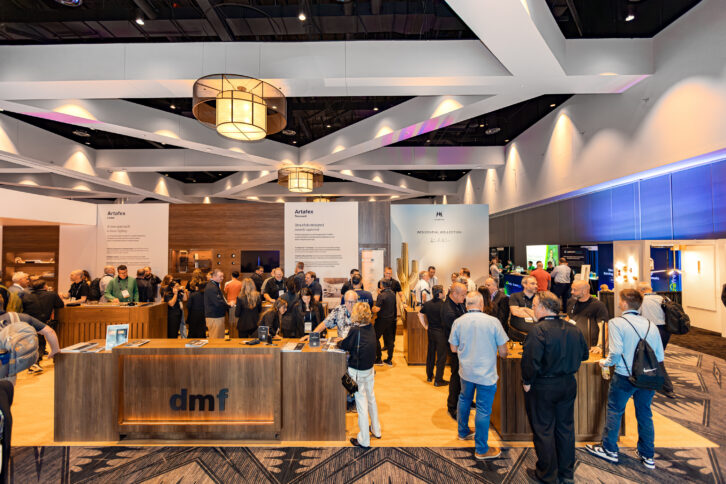
The company also debuted the latest in its PhaseX digital lighting ecosystem, the Artafex PhaseX Gateway with Ethernet. This new gateway adds direct Ethernet connectivity, removing the need for additional DMX control boxes that are traditionally required for digital lighting control.
WAC Lighting/AiSPIRE also had several new product introductions, including its Outdoor X Track System, which provides track lighting specifically for exterior environments. It features field-cuttable sections and flexible connectors that allow for installation versatility.
The Velino.0 Series from Optique features a universal mounting ecosystem in a slim form factor: a 1/2-inch or 5/8-inch narrow housing and a 1/2-inch light aperture. It is offered with a full spectrum of LED options, including Static White, RGB, RGBW, and Tunable White when paired with Optique’s diffuser lens.
Over at the Savant booth, demos were being given of the latest iteration of the Savant AI control platform, which looks nearly ready for prime time and, according to the company, should be ready to ship later this year.
ADI and Control4 got plenty of attention at last year’s show with its Lux keypads, so this year they introduced new black Lux mechanical switch and outlets, as well as new Lux sales tools. ADI also showed new Vibrant Smart Bulbs and Recessed Trim Lights, as well as its WattBox intelligent power solution.
Speaking of keypads, the ever-stylish Basalte was at Lightapalooza with its new wireless keypads, which should be in dealers’ hands by the end of the year.
Luminii made the scene with its Gen 2 LED platform, which updates the technology behind the majority of the company’s LED strip lighting and made-to-order linear fixtures. The Gen 2 platform features a color quality of 97+ CRI and 95+ R9, as well as improved efficacy.
Other floor highlights included getting another look at Coastal Source’s VIA outdoor lighting made in partnership with Lutron, Ubiquity’s line of security and networking products, and PureEdge’s attention-grabbing recessed linear and curved lighting.
Have Some Class
Since its inception, a key figure in Lightapalooza’s education tracks is lighting designer Peter Romaniello, IALD, owner of Conceptual Lighting, and this year was no different. Romaniello hosted numerous sessions throughout the three days, including one called “Lighting for Artwork,” which began with his usual mantra of “always light the walls” and expanding to include a host of helpful tips for lighting paintings, murals, sculptures, and more.
So, if one is already lighting the walls, how do you make the artwork stand out. “Whatever you are lighting has to make sense with everything else in the room. They want to see their artwork, but it also has to be a comfortable house,” said Romaniello. “We have to think about the hierarchy of things: Is one piece brighter than another? Do we want to emphasize one more than another? Flexibility is incredibly important because chances are high that we won’t know what the artwork is when we are setting up the lighting design.
Very Related: Residential Lighting Best Practices Guide 2026 Now Available
“The most important thing is to think in proportion, so, if an ambient light level in a living space is 15 to 20 foot candles, and you want something to be highlighted, it should be double that. That means that, for artwork in that room, I would want somewhere between 30 to 45 foot candles of light.”
While some say there is no research that supports the health benefits of light in the home, Mark Rea, PhD, from the Light and Health Research Center, Icahn School of Medicine at Mount Sinai, would beg to differ, largely because he is generating plenty of it. In his session entitled “The Healthy Home: Lighting to Support the Health of Each Member of the Family,” he shared how the brightness and timing of light can have big impact on the sleeping habits of each person in the household. The rules are bright days, dim evening, and dark nights. Rea recommended, especially in cases where the lighting control is set up before the family moves in, to visit the home after six weeks and ask each person two questions: How well are they sleeping? And how bright is their house is during the day? Then change the lighting based on their answers if necessary.
A panel called “Getting Lighting Right: Lessons from Integrators Who’ve Done It” highlighted the conundrum of integrators getting involved in lighting: having to play on two different teams. The homeowner wants better lighting because the integrator brought it to their attention, but that can create issues for the general contractor. How do you play both sides? By focusing on the experience and by being as communicative and collaborative as possible with all parties. Also, for general contractors, don’t screw up their schedule and don’t screw up their project.

Another panel tackled “Winning with Architects & Builders: Lighting as a Door Opener, Not an Afterthought.” Some of the solutions offered include hosting lunch & learns with local professionals and pulling out those rolls of older plans and taking note of who the architect was on those projects — chances are some of those names will repeat, offering an inroad to working together more formally.
Whichever methods are chosen to reach out to architects and interior designers, the panel warned that it will be a long road that runs mainly uphill. Every architect has been burned by an integrator at some point, so we are guilty until proven innocent. It takes time to overcome that, so plan on five to seven contacts before you get the chance to bid on a project. However, once you make it through, those relationships have a lifetime value of millions of dollars.
The next session sounds too good to be true: “Hidden in Plain Sight: How to Unlock a Six-Figure Revenue Stream with Landscape Lighting.” In it, Ryan Lee, business coach at Landscape Lighting Secrets, made the case that landscape lighting should be a business you should be in because you are already speaking with high-value clients that trust you. And somebody will be selling them landscape lighting, so it may as well as be you. He went on to say how easy it is to do, and he certainly made it sound easy, but still recommended teaming up with an experienced landscape lighting designer for a least five jobs before heading off on your own.
That is just an example of the education available at the show, which also included the SHINEpro Certification Program and AIA- and IDCEC-accredited sessions, as well as a track on power.
We will share the details on Lightapalooza 2027 when they become available. In the meantime, keep up with some of the presenters and exhibitors at this year’s show with the 2026 Residential Lighting Best Practices Guide.