When it comes to private cinemas and high-performance entertainment spaces, one truth stands above the rest: The room itself is the single biggest determinant of success. You can spend a fortune on the finest equipment or choose the most exquisite finishes, but if the space isn’t planned properly from the outset, everything else is compromised.
For architects and designers, this is both a challenge and an opportunity. The challenge is that cinema rooms come with very particular requirements that don’t always align neatly with conventional layouts. The opportunity is that, if considered early enough, these requirements can be integrated seamlessly into the wider architecture, avoiding awkward compromises later.
This is why the first and most important rule in private cinema design is simple: get the space right from the start.
Why Early Planning Matters
Too often, cinemas are treated as an afterthought. A client might say, “We’ll just put it in the basement” or “we’ll convert that spare room later.” By then, key constraints — dimensions, structure, ceiling height, and adjacency to other spaces — are locked in. You can still “make it work,” but it will never deliver the performance it could have, and fixing issues retrospectively is expensive and invasive.
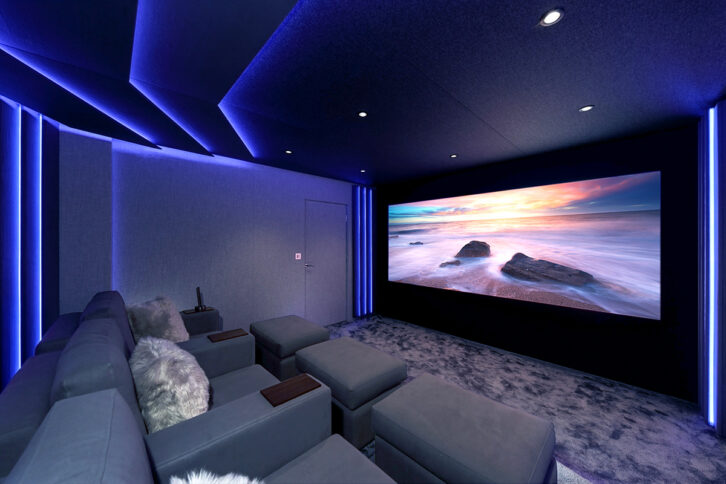
When the cinema designer is involved at RIBA Stage 2 (or equivalent), the room can be shaped with intent. Proportions, clearances, isolation strategies, and technical zones can all be baked into the plan from day one. This ensures that, when the time comes to layer on finishes and equipment, the bones of the space are already optimized.
The instinct is often to go bigger — but in cinema design, bigger is not always better. What matters more is proportion. Certain ratios of width, depth, and height encourage smooth distribution of sound energy in the room, avoiding nasty resonances that color the audio. Architects will recognize the similarity to golden-ratio thinking in other disciplines: balance, not brute scale, is the goal.
Home Theater Week: Superior Suburban Cinema
Ceiling height is particularly critical. Not only does it influence sightlines (nobody wants to crane their neck from the back row), but it also determines the maximum screen size you can comfortably fit. A generous height allows for stadium-style seating layouts and proper screen immersion. Conversely, a low ceiling forces compromises — smaller image sizes, restricted seating tiers, and reflections from overhead surfaces.
Seating: The Anchor of the Room
The starting point for cinema planning is not the projector or the speakers — it’s the seats. The audience is, after all, the reason the space exists. Every other design decision cascades from where people sit. Key considerations include:
- Distance from walls: Placing seats flush against boundaries is a recipe for poor sound, as low frequencies bunch up near surfaces. A meter or so of clearance makes a big difference.
- Sightlines: Each viewer should have a clear, unobstructed view of the screen, with appropriate vertical and horizontal angles. If the screen is too low, the front row cranes upward; too high, and the back rows lose comfort.
- Row count: Be wary of over-seating. More rows often dilute quality. One well-designed row of four seats can outperform three compromised rows of six. Start with the question: How many seats will genuinely be used most of the time?
A common client request is to maximize seating. “We’d like three rows of eight.” On paper, it sounds impressive. In reality, cramming too many people into a modest footprint ruins performance for everyone.
The front row ends up too close to the screen, the back row too near the rear wall, and the middle squeezed in between. Sound becomes uneven, sightlines awkward, and comfort sacrificed.
A smarter approach is to tailor seating to actual use. If the family will typically watch as a group of four, design the room around an exceptional experience for those four. A second row can be added for occasional guests, but not at the expense of the primary seats.
Technical Space: The Hidden Hero
Cinemas are technology-heavy rooms, but the best ones don’t look it. Projectors, amplifiers, servers, and cabling all need somewhere to live. If these are crammed into joinery at the back of the main room, you inherit heat, noise, and maintenance headaches.
The ideal solution is a small tech room behind or adjacent to the cinema. This allows the projector to fire cleanly through a port window (as in commercial cinemas), while the racks hum away silently out of sight. For architects, this is a gift: a chance to conceal complexity and preserve the purity of the main space.
Acoustic Isolation: Don’t Disturb, Don’t Be Disturbed
Private cinemas are often located in basements or within family homes. Without isolation, sound leaks out — disturbing the rest of the household — and external noise leaks in, destroying the immersion.
High-performance isolation typically requires independent layers of structure, with air gaps and specialist materials. This can add up to 400mm of build-up on each surface. That’s a lot to “steal” from a plan if it wasn’t allowed for at the start. With early design, clever detailing can reduce this footprint, but it must be considered in the space budget.
Speakers, Subs, and the Importance of Exactness
Unlike lounge speakers that can be shuffled around post-completion, cinema loudspeakers and subwoofers are precision instruments. Their locations are governed by strict geometry: angles, distances, and phase relationships. Move them a few centimeters off, and performance suffers.
This is why even door placement can matter — an opening in the wrong spot can collide with a critical speaker location. Early coordination between architect, interior designer, and cinema consultant avoids these conflicts.
Case in Point: The Domino Effect
Imagine a client decides late in the project to add a cinema to a 6.5m x 5.5m basement. The ceiling is 2.4m. They want three rows of seats, for 12 people. Immediately, problems arise:
- The ceiling won’t allow for proper screen height or risers
- Seats against walls mean poor bass response, and poor overall experience of immersion
- Isolation eats further into already tight dimensions
- Equipment has to be ceiling-hung, adding noise and visual clutter
- HVAC becomes paramount
Contrast this with a project where the cinema designer is engaged at Stage 2. The rooms’ design is adapted to accommodate a 3m ceiling. A tech room is tucked behind. Two rows of four seats fit perfectly (five with a push to more compact seating), with isolation layers factored in. The result? A clean, elegant room that works acoustically, visually, and architecturally — without last-minute compromises. And let’s face it: If you’re trying to shoehorn 12 seats for 12 people into a small room, you should have run from the project early. Where else in the clients’ home do they accommodate 12 people in such a small setting?
The Architect’s Role
For architects, the cinema should not be an alien bolt-on, but rather another finely tuned environment. Just as you would consider daylight, circulation, or materiality, you can consider acoustics, sightlines, and technical adjacencies.
Home Theater Week: From Aspiration to Accountability – Private Cinema Comes of Age
Your role is to give the cinema designer the canvas to work on: the right proportions, the right adjacencies, and the right allowances. Do this early, and you unlock possibilities that simply don’t exist once walls are poured and ceilings set.
Conclusion
Getting the space right from the start is the single most important factor in private cinema design. It’s not about being “big enough,” it’s about being thoughtfully planned.
With the right dimensions, seat placement, technical zones, and isolation strategies built into the architecture from day one, you create the foundation for a room that can deliver true magic.
Leave it for later, and you’re forever fighting compromises. Plan early, and the cinema becomes not just a technical marvel, but a seamless extension of the architecture, a space that feels as intentional and considered as any library, office, bedroom, or kitchen in the home.