As video walls continue to make inroads year after year, more models are now available at a variety of price points. And as customers take note, opportunity grows.
“Once homeowners have seen a wall‑filling, bezel‑free image that works with lights on, one that’s very hard to unsee, their thinking shifts from big TV and projection to cinema canvas,” says Lenny Kleyman, CTO, AWALL. “However, the real inflection point has been the evolution from traditional SMD [Surface-Mounted Device] LED to COB [Chip on Board] MicroLED. As soon as we crossed into sub‑1.0mm pixel pitch, it stopped being a ‘trade show technology’ and started looking like the clear future of immersive display for real living rooms and dedicated theaters. AWALL COB MicroLED gives homeowners a seamless, high‑brightness, high‑contrast canvas with no burn-in, no viewing‑angle penalties, and no light control requirements, so it can replace projection and oversize flat panels in almost any environment. For dealers, that same technology shift has turned video walls from custom one‑offs pieced together into a repeatable category they can confidently specify and support.”
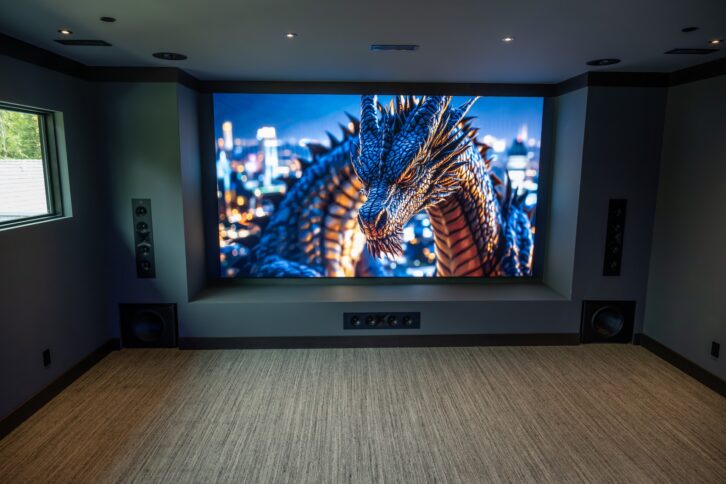
“Video walls are increasingly embraced in homes because they offer immersive, large-format viewing experiences that go beyond a single TV,” notes Robert Meiner, technical sales engineer, Peerless-AV. “The wider availability of thinner bezels, lighter panels, and more efficient mounting systems means these setups are now more practical for residential spaces. Coupled with competitive pricing and rising home entertainment expectations, we’re seeing the popularity of video walls outside of commercial use and coming into the residential market.”
“Big factors to consider are overcoming the video wall learning curve and being careful to find a reputable supplier,” cautions Skyler Meek, CMO, Just Video Walls. “There are at least 20 fly-by-night companies for every one reputable company, and they are selling poorly specified products. For example, we recently lost a job that had two outdoor spaces for video walls to a company that sold indoor-rated walls into the outdoor environment. Those two walls will fail within four to five months.
“In addition, these companies are and have been mostly transactional, without real processes behind them in how to design and spec walls properly,” he continues. “It’s 100 percent about the price point and so-called specs of the product they’re offering. Dealers are left with zero confidence that the expensive video wall is actually the right pixel pitch, for example. The number of dealers who have come to us saying they did a MicroLED install once, it went terribly, and they decided never to do it again is alarming. We are definitely in the Wild West right now.
“Think about it,” he notes, “you’re selling a high-cost product with built-in expectations of high performance and high quality, and there are hundreds of ways it can go wrong. What we’re seeing is that our dealers are really behind MicroLED now that they have the confidence, knowledge, and authority to sell, specify, design, and install these systems, knowing that the end result is going to be awesome, and last for a long time.”
The Offerings
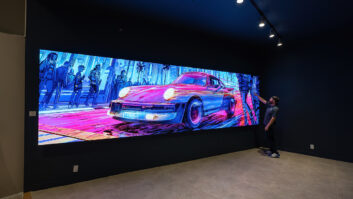
“Our Just Video Walls line is 100 percent custom-made and designed for each project,” Meek says. “What makes the product category so great is that we are now relieved from all the major ambient light concerns that we’ve been plagued with for so long. Most of our installs are in multimedia rooms or in open-concept theaters with pool tables, ping pong, workout rooms, and large windows with outdoor pools nearby. On top of that, the pixels are all self-lit, so the vibrancy and contrast are more like OLED displays. We have a product that now dominates the experience and brings it in such a new way that customers are seriously jaw-dropped when seeing it for the first time.”
According to Meek, the Lunar Walls brand has two popular products. “One is Expanse, which has three ratio options, 16:9, 32:9, and 48:9, highlighting another great reason why MicroLED is what we believe to be the future of display,” he says. “They can be all sorts of aspect ratios. On the Expanse product, we wanted to take the design and customization out of the category, so these are much faster and easier to specify and are also available in stock at distributors across the Americas. We’re seeing a lot of 16:9 still, but so many of these projects are quoting wider aspect ratios because it’s something cool that no one has ever seen before.”
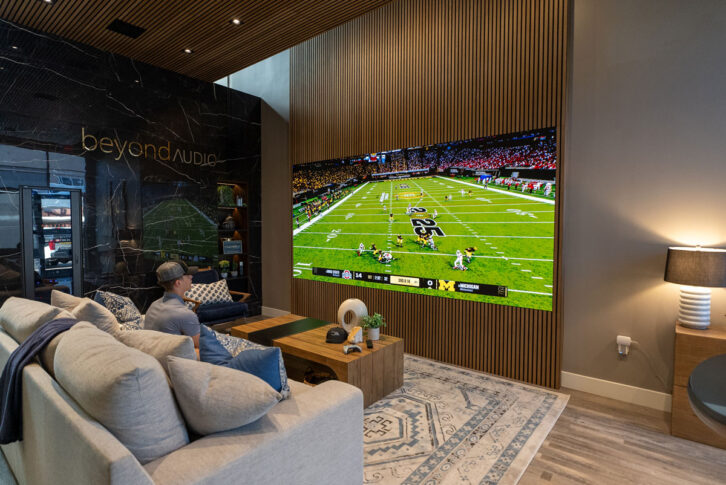
AWALL, Kleyman says, has taken everything that was once reserved for elite commercial projects — COB MicroLED, sub‑1.0mm pixel pitches, hyper-realistic image quality, deep blacks, and class-leading peak brightness — and engineered it into residential packages in the 108-inch, 135‑inch, 162‑inch, and larger custom classes. “The result is a family of AWALL MicroLED walls that deliver reference‑grade image quality, with 100,000‑hour lifespans, in technically approachable packaged solutions, while still hitting the most competitive price points in the category,” he says. “The incredible sell‑through we are seeing is not driven by race-to-the-bottom pricing; it is driven by integrators recognizing that AWALL pairs best‑in‑class internal components and engineering discipline with pricing that finally makes MicroLED attainable for a much broader slice of the residential market.”
Peerless-AV’s latest video wall offering is the Seamless Connect Universal dvLED Mounting Systems. “With top-notch features including an ultra-low profile, highly adjustable for alignment, and built for both standard and custom configurations, Seamless can be used in any room in any home,” Meiner notes. “Pricing has always been a factor, so with the Seamless system, there are a variety of different options available to meet both the needs and pricing expectations for the end-user.”
His best tips for handling the sales and installations of displays are to first emphasize the display’s visual impact and its benefits. “Regarding installation,” he says, “it’s imperative to consult with and have an installation representative from the mounting and display manufacturers on site to help with any alignment, support, or assist with any unforeseen issues that may arise during install.”
“The most successful partners lead with the story of MicroLED’s evolution and position it as the natural successor to every other large‑format technology,” Kleyman says. “When clients understand that the same COB MicroLED architecture used in high‑end commercial and broadcast walls is now available in a turnkey residential product, the conversation shifts from ‘Why is this so expensive?’ to ‘Why would I invest in anything else?’ On the execution side, the magic really happens in our kits; every wire, screw, and trim piece is included, so the out-of-flight-case experience is stress-free. The second most important tip is for integrators to start treating the MicroLED wall as a core architectural element, locking in structure, power, and sightlines early. Standardizing on proven configurations allows dealers to deliver repeatable results at scale. That is how MicroLED moves from the impossible to obtain category to a disruptive new baseline, and AWALL is proud to be one of the brands pushing that shift in the residential channel.”
Related: The Rise of the High-End Video Wall
“One of the biggest challenges in this industry is understanding how to sell based on the experience and lifestyle rather than jumping into specifications,” Meek says. “Our dealers do a great job at this, and if you talk to them, you’ll get a quick sense of why they are so successful. Questions are more focused on the client and the ‘why’ behind the client’s home or business rather than just pitching products, numbers, and dollars.
“Of course, the all-time most successful strategy is having a place for clients to see the displays,” he adds. “Our dealers are investing in demo walls and getting a return on those investments within weeks of the installs. And it’s easy to understand why once you’ve seen one of these walls on display. The image is just incredible and unlike anything else anyone has ever seen before. Often, when we just allow a client to walk in and see the wall, it’s no longer a question of explaining what it is and going through a traditional sales process. It’s akin to selling lighting. Once the customer sees it, they understand, and the conversation turns to what size they can fit in their home.”