Kudos: Turntable build quality clear at every touchpoint; Denon Home 400 produces big sound and full bass; Simple, reliable operation
Concerns: Siri requires separate Apple device; no room correction; Bluetooth multi-device switching can be tricky
In 1910, Frederick Whitney Horn founded Japan’s first-ever audio equipment company. Today, this company is known as Denon, and there are few brands remaining in our industry with Denon’s legacy, history, and heritage. (For trivia buffs, Thorens, established in 1883, is the longest-running audio manufacturer.) While Denon has been continuously making professional and consumer audio products ever since, the company’s inaugural product was Japan’s first gramophone, meaning Denon can trace its turntable roots back 116 years!
I can trace my personal experience with Denon turntables back to the late ’80s, when I worked as a stockroom employee at The Goodguys! store. One of the best turntables we sold was the venerable Denon DP-47F. This was a fully automatic deck with a heavy rosewood base that could sense the size (33 1/3 or 45) of the record, and then automatically pick the right speed and drop the needle on the opening grooves. It sat impressively in the rack of our high-end demo room, and whenever one was sold, it was always a little thrill to go and retrieve it off the shelf and carry it out to the lucky new owner.
Denon launched a new flagship direct-drive turntable in 2023; however, at $2799, the DP-3000NE is certainly geared toward vinyl aficionados and not those looking to dip their toes in the vinyl resurgence. With the launch of the DP-500BT, reviewed here, Denon has delivered a deck that delivers premium performance with the modern twist of Bluetooth streaming, but at a far more approachable price of $899, with key learnings from the DP-3000NE carried forward into this model. While this might not attract those new to vinyl, it certainly offers an attainable upgrade path for someone looking to take the next step on their vinyl journey.
Vinyl sales in the U.S. rose for the 19th year in a row to 47.9 million units. According to Luminate, a major provider of music, film, and television analytics, buying habits are also shifting across physical formats, as direct-to-consumer sales have grown to 13.6% of all physical albums. These trends show a clear and continued appetite for music on physical media, and one that the Denon DP-500BT is ready to support.
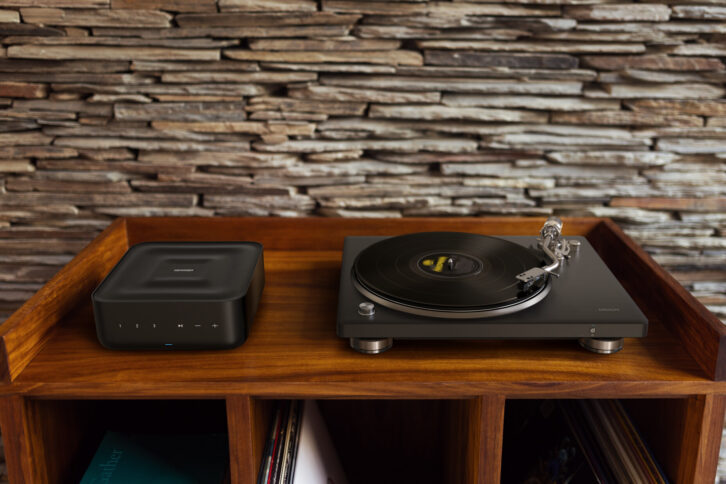
At virtually the same time as the release of the DP-500BT, Denon also released three new wireless speakers to its Denon Home Series: the 200, 400, and 600. While these products can certainly be used independently, since the new Home speakers all support Bluetooth streaming, they make perfect companions to test whole-house turntable streaming with the DP-500BT, so Denon also supplied the Denon Home 400 speaker for review.
First Impressions
In truth, my experience with turntables is fairly limited. Besides a Fisher Price children’s record player I had growing up, my first true experience with owning a turntable came about two-and-a-half years ago when I reviewed the Victrola Hi-Res Carbon (review available online). Since that review, I have probably listened to less than 10 hours of music on the Victrola. Nothing against it. It’s just that vinyl listening is a “whole thing” that really requires active participation that I generally eschew in favor of streaming something off Tidal.
Nonetheless, I was excited to experience the DP-500BT in my system as it would be another reason to go back and give vinyl another serious listen, especially as it pertained to whole-house streaming with a HEOS system.
Honestly, my first impression after opening the DP-500BT’s box was a bit of being overwhelmed at the sight of all of the parts and pieces. I was also quite pleased to see a well-written, full-fledged owner’s manual that not only detailed the entire setup and installation process, but also full operating instructions.
If ultra-high-end demos at CES have taught me nothing else about turntables, I know that having a solid, stable deck and platform that isolates and eliminates any stray vibrations is a crucial starting point. While not over-the-top, the Denon’s near-14-pound weight gives it some nice heft that makes it feel like a well-constructed product. (In contrast, the flagship DP-3000NE weighs nearly three times as much at 40.79 pounds.) It also sits on some dense rubber feet that help to stabilize the base and further isolate any vibration noise.
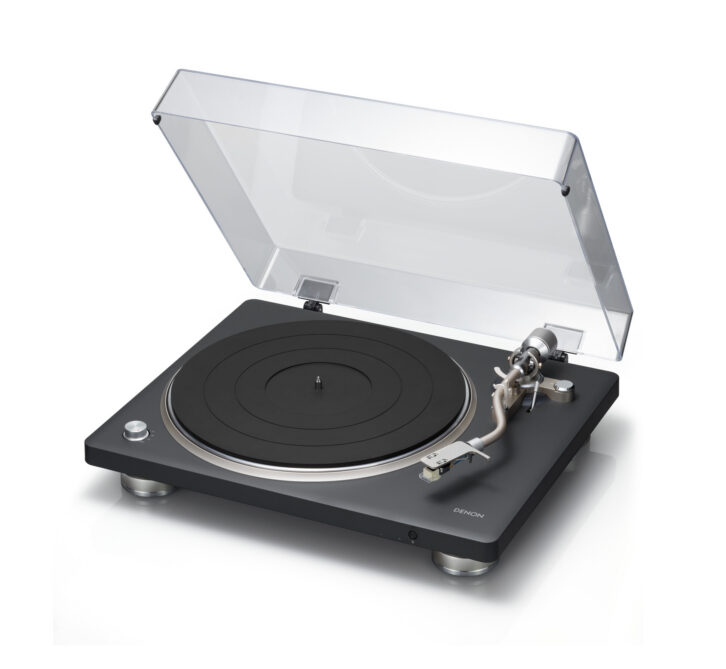
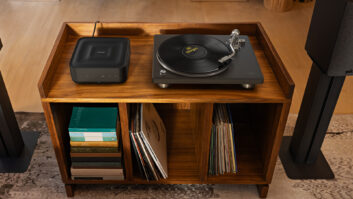
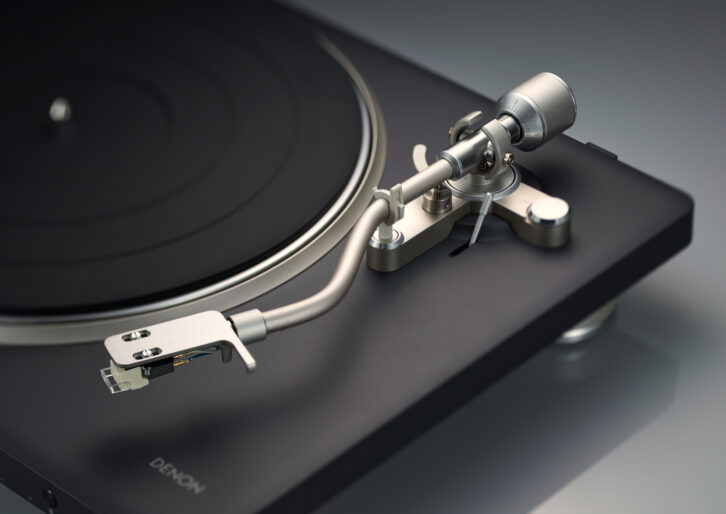
The deck is a charcoal, dark gray color, with silver accents on the front of the platter, tone arm, speed selector, and stabilizing feet. It’s modern minimalist and cool-looking for sure. While installation is optional, I also appreciated the traditional, hinged dust cover.
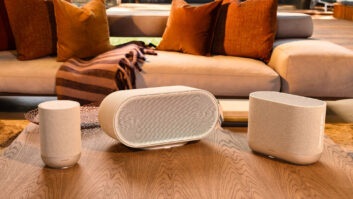
The Denon Home speaker lineup is offered in either Stone (a kind of off-white) or Charcoal (dark gray) finishes. To quote Denon, “The Denon Home [speakers] were designed not only to deliver exceptional sound, but to sit comfortably within the fabric of everyday life. Denon’s engineering and design teams began with a simple question: What if a speaker could truly feel like part of the home?”
If you like flowery PR descriptions, then you’ll appreciate Denon’s poetic description: “Each model uses seamless woven fabrics, precision anodized aluminum, smooth touch finishes, soft silicon, and simple geometric forms that look natural in a modern interior. These surfaces flow into one another with intentional continuity, creating a warm and human presence rather than something purely utilitarian.”
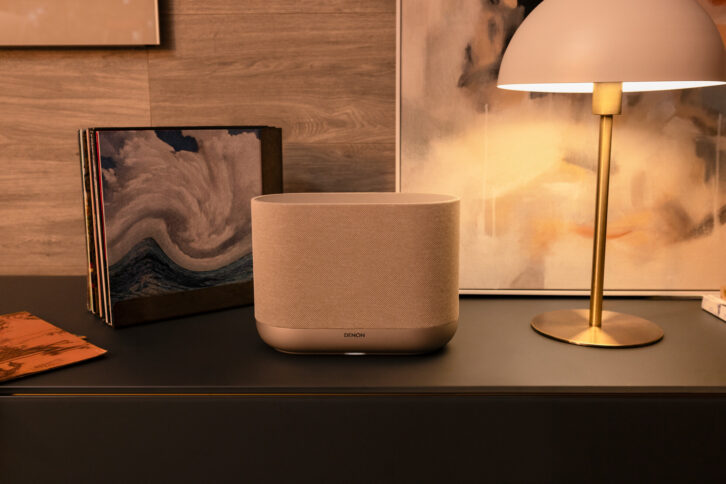
Translating this into human-speak, the Denon Home 400 sits in the middle of Denon’s new Home lineup, and has nice, rounded edges that are designed to not draw any attention to themselves. Did it truly feel like part of my home? Meh. But the speaker can easily sit on a counter or desk and co-exist with things around it. If anything, the 8.6-inch height might be a little tall for some. I appreciated that Denon built a threaded insert into the bottom of the speaker should you wish to stand- or wall-mount it.
Setup
After removing and unwrapping all of the DP-500BT’s parts from packaging, you’re left with a host of pieces that need assembly. This includes the turntable itself, the platter, the platter mat, the dust cover and hinges, the head shell with cartridge, the counterweight, the AC adapter, and audio cables. Fortunately, the manual breaks this down in a step-by-step manner with pictures to get everything installed correctly.
The turntable uses a belt to turn the platter, and installation involves stretching the belt over the spindle, a process that is simplified with a taped guide string. After the belt is secured, you set the thick silicone mat cover on top of the platter.
The included Denon DSN-85 Moving Magnet stylus mounted into a universal headshell slips and locks into the S-shaped tone arm. A bit trickier is mounting and installing the counterweight and setting the anti-skating dial to adjust the stylus for the correct pressure of 2.0 grams for the included stylus. Again, after a few minutes of trial-and-error and consulting the manual, I was able to get this dialed in. (The turntable fanatics out there will correctly note that using a dedicated stylus pressure gauge is really the best way to ensure the most accurate installation. However, with Denon’s instructions, I feel like I got it as correct as I needed.)
For those interested in upgrading the stock cartridge, Jim Garrett, VP of product management for Sound United at Harman, suggested the Denon DL-103 moving-coil cartridge paired with an amplifier/pre-amp that includes a moving-coil phono input. Garrett said, “It’s a classic combination that delivers excellent performance and highlights the turntable’s capabilities.”
A phono-level signal is much weaker than a line-level signal, typically less than 0.005 volts compared to around 0.3 volts for a line signal, so this signal needs to be properly amplified. If your receiver has an input labeled “Phono,” then it has this pre-amplifier (and RIAA equalization) built-in. If it doesn’t, then you’ll need to use an outboard phono pre-amp.
Conversely, many modern turntables have this pre-amp built-in, internally converting and outputting a line-level signal compatible with any receiver. The Denon includes both, with an equalizer on/off switch on the back to select your preference, allowing it to work with any system, which is good, because my Trinnov Altitude only has a single RCA analog input that only accepts line-level signals.
One of the DP-500BT’s big features is an integrated Bluetooth transmitter, supporting Qualcomm aptX Adaptive that can deliver up to 24-bit/96 kHz resolution. This is also backward-compatible with aptX HD and aptX codes, as well as non-aptX devices using SBC. For someone looking to assemble a simple but high-performing vinyl system, they could pair this deck directly with a pair of wireless speakers or headphones, which would be a perfect dorm room or small-office solution. The deck supports up to eight different device pairings.
There is a simple selector dial on the top of the deck labeled Off/33/45/78 to select playback speed or turn the deck off. There is also a small button on the front that turns Bluetooth on/off, with a corresponding LED to show the status: red for on and RCA, blue for Bluetooth SBC, and purple for Bluetooth AptX. It’s nice that both the Bluetooth and the RCA outputs are concurrently active, letting you listen in two different ways simultaneously if desired. Underneath the deck’s front edge are two discreet Bluetooth volume buttons, which are also surprisingly handy.
On the back of the unit is an On/Off switch for the platter’s Auto-stop feature. When set to On, the platter will stop spinning, and the tone arm will lift the stylus when it reaches the label at the record’s end. When set to Off, it just keeps spinning the record with the stylus knocking up against the record label. Why someone would turn this off, I don’t know, but it’s there.
I also liked that the Denon has detachable cables, with gold-plated RCA outputs letting you use upgraded or different-length cabling as needed. I’ve seen several decks that have permanently affixed cables, and if they get damaged, you’re forced to make a splice.
The Denon Home 400 features a six-driver design, with two 4.5-inch mid-bass and two 0.75-inch tweeters that are front-facing, and two 1-inch upfiring drivers to create height. There are 90 watts of total power across six digital amplifiers. Should you desire more output, the Home 600 steps up to eight speakers, using dual opposing 6.5-inch subwoofers for deeper bass, along with an array of tweeters, 2.5-inch midrange, and 2.5-inch upfiring drivers.
The only setup required for the Denon Home 400 is adding it to your HEOS account. Since I already had two HEOS devices, this was a simple proposition, but if you’re starting from scratch, you’ll download the free iOS/Android HEOS app, create an account, connect to the speaker, and then it will walk you through connecting to your Wi-Fi network. During initial setup, the app asks about the speaker location, whether it is located away from walls, near one wall, or near two walls. This is to help with boundary gain compensation on the bass performance.
HEOS has grown immensely as a platform and now natively supports Spotify, Deezer, SiriusXM, SoundCloud, Amazon Music, Qobuz, Pandora, TuneIn, iHeartRadio, and Tidal. High-resolution streaming is supported in resolutions up to 24/192 via Tidal Connect, Qobuz Connect, and Amazon Music HD, and Dolby Atmos listening via Apple Music, Amazon Music, and Tidal. You can also use Bluetooth or Apple AirPlay 2 to wirelessly stream content to it.
As part of the HEOS ecosystem, the Denon Home 400 can connect with up to 64 other HEOS products across 32 zones. It can also pair with a second Denon Home 400 to create a stereo listening zone, pair with wireless subwoofers powered by HEOS, and be used with the Denon Home Sound Bar 550 as rear speakers for a full Dolby Atmos surround system.
On the right side of the speaker are a set of buttons should you need basic control without a device. These are Volume +/-, a multi-function Play/Pause, Voice Assistant, and three quick-select presets. Around back is a Wi-Fi Connect button, mini-jack analog Aux input, USB-C input, Bluetooth button, and a physical microphone On/Off switch, along with a detachable power connection.
Compared with Sonos, which allows you to touch and swipe across the top of the unit for local control, I found these buttons more difficult to access and not very useful, but they’re there if you need them.
Within the app are two sound control settings: Automatic and Pure. Pure “eliminates surround processing by removing any adjusted audio characteristics for sound in its purest state,” while Auto allows you to adjust bass and treble along with the soundstage width and height in ±5 dB steps.
The Denon Home 400 also has a multifunction light on the front, bottom-center. Those sensitive to light pollution will appreciate that the HEOS app allows you to dim/defeat this light if placing the speaker in a bedroom or other area.
Getting the DP-500BT paired with the Home 400 was a simple process of pressing and holding the Bluetooth button on the turntable until the front light started blinking blue, and then pressing the Bluetooth button on the back of the Denon Home 400 speaker. They immediately found each other and connected. Now, because this is a Bluetooth signal, the distance and obstacles (walls, mirrors, metal, etc.) between the turntable and speaker will affect the Bluetooth signal connection quality and range.
Performance
The entire record listening experience is highly tactile and involving. You walk over and choose an album. You pull the album from the jacket and remove it from its sleeve. (At this point, you should obsessively clean any dust from the album, but you probably won’t.) You open the dust cover and gently place the record onto the spindle and mat. You click the speed selector wheel over to 33-1/3. You lift the tone arm and then glide it over to the beginning of the record. And finally, you lower the needle onto the album and close the dust cover.
There is something about the absolute analog-ness of the “needle drop.” Carefully gliding the stylus over to the edge of the spinning record, gently lowering the tonearm down, watching as it catches those first grooves, and then hearing those opening crackles before the music begins. Pressing Play on a CD or stream doesn’t come close to being as satisfying.
It’s an entire little ritual that has you engaged and hands-on at every moment. And at only 22 minutes per album side, you are almost constantly getting up to flip sides and repeat the experience. This also means you don’t just pop on an album and then wander around the house doing something else. (Though, with the HEOS streaming, you certainly can.) Vinyl practically demands active listening.
Listening to vinyl is a way of tapping into this lost music listening experience, and the DP-500BT feels solid, stable, and purposeful at every touchpoint. True audio geeks will know the term “knob feel,” and that’s what this turntable delivers. From the lift and hold of the dust cover, to the proper resistance and clicking of the power/speed selector, to the smooth glide of the tone arm, to the tone arm’s raise and lower lever. At every point, it just feels like a thoughtfully designed, well-crafted deck.
The majority of my actual album listening was done using my daughter’s album collection, which included heavy rotation of Taylor Swift, Lana Del Rey, and Kacey Musgraves via Bluetooth to the Denon Home 400 and my Mark Levinson No. 5909 headphones. (Can anyone explain why new records cost so dang much? Nearly every album at Target is $40 or more!)
When connecting to an audio system, note that the DP-500BT’s line-level output is rated at 150 mV (0.15 volts), which is on the low side. When playing through my Trinnov Altitude, I had to raise the volume pretty high to get to listenable levels.
Bluetooth operation couldn’t be simpler, and once paired with the Home 400, a single press of the Bluetooth button on the turntable sent music to the speaker. It just worked, every time. And being able to adjust the volume from the turntable was surprisingly useful.
When you add in a second device — such as my Levinson headphones — connecting can be a little trickier, as the turntable wants to grab the last device connected. If you want to stick with that device, great, but if you want to switch to the other, sometimes that meant having to put the headphones back into pairing mode for them to reconnect, or having to push the Bluetooth button on the back of the Denon Home 400 speaker for it to connect.
Whole-house album listening is also a simple process and done in the HEOS app. Once the turntable is connected to the Denon Home 400, you just group in other rooms where you want to listen, and it adds them, playing the record in perfect sync.
Right from the jump, I was impressed with the wall of sound that the Denon Home 400 produced. Usually with small, tabletop speakers, I’m bemoaning the lack of bass, but the 400 actually bordered on being too bassy, especially at its first location in a corner of my room. A couple of clicks down on the bass level helped this, but ultimately relocating it out of the corner was the best solution for me. I do wish the speaker offered some form of room correction akin to Sonos’ TruePlay.
The Denon Home 400 delivers nice deep, low-frequency bass extension even at low volumes. For example, the deep drums in “The Battle” from Hans Zimmer’s Gladiator soundtrack sounded full and deep even at near-background-listening levels. But it can also be loud and room-filling when you want it to be. For its size, bass is surprisingly big and detailed, producing tactile low-end that I could feel at my listening position.
I always like when the audio format is clearly displayed, and when playing Atmos-encoded music via Tidal it shows the Dolby Atmos logo and the format as “Dolby Atmos – Dolby Digital Plus” Quality “767 kbps.” Listening to Atmos music delivers a nice amount of spaciousness that is definitely sonically “bigger” than non-Atmos audio. “Tom Sawyer” from Rush in Dolby Atmos is really full, letting you appreciate the width and depth of Neil Peart’s drum play, and heavily processed pop content also benefits from Atmos.
Regarding the sound mode options, I preferred using Pure on native Atmos content. This seemed to keep vocals more centered and less processed. And on non-Atmos content, I liked the added width and height of the Automatic upmixing.
Even with Atmos audio and width expanded, a single speaker’s weakness is always going to be presenting a soundstage that expands beyond its boundaries. As you get closer to it — say 8–10 feet and less — it is really a point-source device. Sure, there’s a lot of sound coming out of it, but instead of that illusion where you’re listening to a broad arrangement of instruments, it kind of collapses into just coming out of the speaker. Ultimately, you can only do so much to overcome the actual physics of audio originating from a single location. But, good news! You can add a second Home 400 speaker and link them as a stereo pair!
One thing that was a bit of a disappointment was the “Voice Assistant” feature. I was hoping to be able to “Hey, Siri” some music to it from my bed, but the Home 400 is voice-assistant ready, and using Siri voice control requires that an Apple HomePod or Apple HomePod mini be connected to the same network as the speaker. According to Garrett, “The Denon Home 400 supports Siri via Apple’s ecosystem rather than direct, onboard activation.” So, even though it does have a built-in mic, you need a third-party (Apple) device to actually use the voice control.
The DP‑500BT and Denon Home 400 feel like Denon at its best: a blend of heritage, thoughtful engineering, and modern convenience. The turntable delivers the tactile, analog ritual vinyl lovers crave, while the Denon Home 400 brings surprising scale, bass, and whole‑house flexibility. If you’re looking to step beyond entry‑level vinyl without diving into the deep end of audiophile pricing, and you want the option to stream that experience anywhere in your home, this pairing hits a sweet spot. They stand strong on their own, but together they offer a compelling, future‑friendly way to enjoy records in a modern system.
800-497-8921 — Denon.com
Product Specs:
DP-500BT
- Belt-driven, semi-automatic turntable (auto stop on/off switch); 33-1/3, 45, 78 RPM playback speeds
- Includes Denon DSN-85 MM stylus; universal headshell for easy upgrading
- Phono equalizer switch for use with systems without phono input
- Bluetooth SBC, aptX, aptX HD, aptX Adaptive
- 20 Hz–20 kHz frequency response; 62 dB S/N; 0.1% (WRMS) wow & flutter
- Includes removable/hinged dust cover
- Inputs: None; Outputs: RCA stereo, Ground, detachable power
- Dimensions and Weight: 8 x 14.1 x 4.65 inches (WxDxH); 13.7 pounds
Denon Home 400
- HEOS wireless streaming audio speaker; can connect with up to 64 HEOS products across 32 zones
- Can be paired with a second Denon Home 400 for stereo, with wireless subwoofers powered by HEOS, or with Denon Home Sound Bar 550 for full surround system
- Six-driver design; 2 x 4.5-inch mid-bass, 2 x 0.75-inch tweeters, and two 1-inch upfiring drivers; 90 watts total power across six digital amplifiers
- 4/5/6 GHz Wi-Fi 802.11 a/b/g/n/ac/ax, Bluetooth, Apple AirPlay2
- High-resolution streaming up to 24/192 via Tidal Connect, Qobuz Connect, and Amazon Music HD; supports Spotify Connect; Dolby Atmos playback
- Inputs: USB-C, 3.5mm Aux, Outputs: Detachable power; Microphone on/off; threaded insert (6.35 x 10mm) for optional stand/wall mounting
- Dimensions and Weight: 11.8 x 5.9 x 8.6 inches (WxDxH); 9.26 pounds