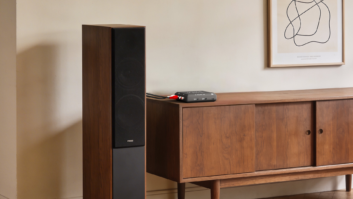
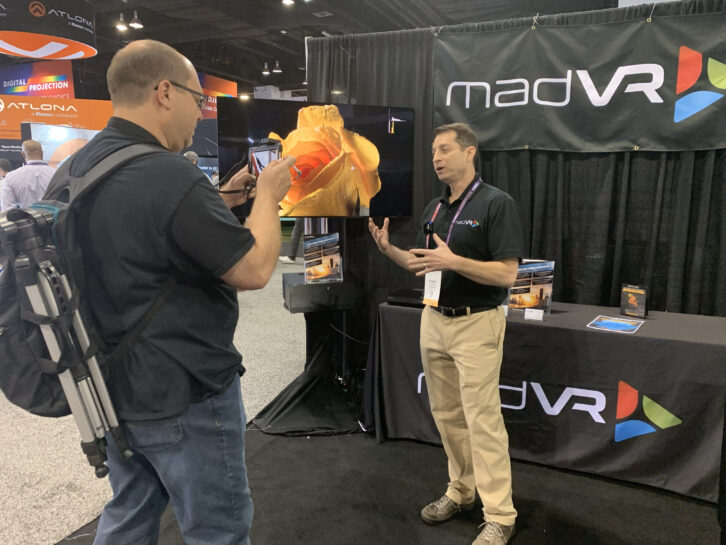
In 2019, Richard Litofsky, co-founder and CEO of madVR Labs, made his debut at CEDIA Expo with a modest 10 x 10 booth and a mostly finished prototype of what would become the company’s launch product: the madVR Envy video processor. From those slight custom industry beginnings — and through global pandemic and supply-chain issues — the Envy would soon develop into the video processor for luxury home theaters and eventually find itself featured in nearly 20 exhibits and displays at the 2025 CEDIA Expo.
However, like most “overnight sensations,” its success was not instant, but borne out of years of development and the dedication of a small, yet passionate, team.
Solve Your Problem, Change the World
madVR Labs had its beginnings in the frustrations of Litofsky. “I’ve been a technology guy my whole life, and I am especially passionate about home theater video,” he says. “Eventually, in 2012, I started work on what would become a three-year project for what I like to call my ‘midlife-crisis home theater.’ I took over much of the basement in my house and turned it into a high-performance theater. The whole family was excited about it.
“Everything for this theater was meticulously planned,” he continues. “We did so many renders, and, because of that, we knew exactly how everything would come together. Back then, a lot of what I was trying to achieve just wasn’t common conversation in the residential space yet, especially around things like room isolation and HVAC design. When I brought these details up, many of the integrators I spoke with hadn’t really been asked to build to that level of performance before.”
In what would become a recurring theme, Litofsky took matters into his own hands, engineering most of the room himself, except for the acoustic treatments, based on online research and consulting with various professionals, including HVAC experts. “Even the HVAC companies that I would call thought I was nuts,” he confesses. “I was talking about oversized air supplies, and it had to be super-quiet, and no one would agree to build to my specifications. I finally found one company that was willing to take on the job, and so we built it together.”
Litofsky, a serial entrepreneur, took that level of detail across every part of the home theater, and he was not satisfied with the video performance of the high-end system. “I had a good-quality projector, a great screen, good sight lines, and an awesome main seating position, but the video was very underwhelming,” he recalls. “This was in the early days of HDR, and there wasn’t any dynamic tone mapping. Watching HDR was painful because the SDR experience was better, and I wasn’t willing to settle.”
Enter Mathias Rauen in 2017, the inventor of madVR and soon-to-be co-founder of madVR Labs. Rauen was (and is still) based in Germany, where he had been making and distributing software under the “madVR” name for users of home theater PCs. The software offered incredible dynamic tone mapping and upscaling, and was a huge hit among video enthusiasts online.
“Mathias built this software as an enthusiast’s project, created to share his passion with others who love this stuff as much as he does,” says Litofsky. “He had a great following with hundreds of thousands of users. I was aware of the work that he was doing from being into the hobby myself, but I wasn’t interested in building a home theater PC and handling all the complexities that come along with maintaining such a system. I wanted to push a button and have it ‘just work’ and maintain itself automatically.
“I reached out to him and let him know that I needed a product that offered the level of video quality he was producing, but beyond that, that I am an entrepreneur,” he continues. “I saw a big opportunity in the market for something that produced madVR-quality video but was simple to use and integrator-friendly, and I suggested we put our heads together and create a company. He said that he figured the day would come to commercialize his efforts sooner or later, and so we hit it off and formed the company, spending a couple of years planning.”
Laying the Foundation
“Our goals were really simple,” says Litofsky. “We had two main things that we wanted to make sure we delivered on. One is we wanted the absolute best picture quality on the market, and two, we wanted incredible ease of use, where just a single button was sufficient. We established a founding principle that ‘every pixel counts,’ which became the company tagline. Video displays are great, but their performance can often be taken to a whole new level with our processing. We look at it as our job to prepare the pixels for the display, and the display’s job to leverage its core strengths to paint an amazing image on the screen.”
The first products the company produced were the madVR Envy Pro and Extreme, which mainly featured the HDR Dynamic Tone Mapping, upscaling, and artifact reduction that Litofsky craved.
Once the duo had a product, they needed to distribute and sell it, and Litofsky had just the market in mind for that. “We decided to sell through high-end custom installation dealers and distributors rather than direct to end customers,” he says. “A big part of that was my own personal experience and wanting to work with integrators to help do my part to bring the industry forward. For the next enthusiast who faced the same challenges as I did, I wanted that person to be able to turn to a professional and have them say, ‘Oh, there’s this product we use to solve that!’
“Both Mathias and I absolutely love sharing the madVR picture quality that the Envy delivers. We get really excited about that. Custom integrators help get the word out and can share our passion for video quality far easier than trying to get the message out one-to-one with end users.”
Armed with a prototype and the desire to show the custom installation industry what’s possible, Litofsky made that fateful trip to CEDIA Expo 2019, where he finally found his people. “When I got back from the show, my family asked how it went. I said, ‘Do you know when I talk about the Envy at dinner, and you look like you can’t possibly hear about this again? This was the opposite, with people hanging on every word and asking more questions,’” Litofsky says with a smile.
And while integrators were very interested in the Envy, he found another super-excited audience: display manufacturers. “At CEDIA Expo, word started getting around,” Litofsky remembers. “I went over to one manufacturer and knocked on their door after hours and said, ‘Can I show you guys something?’ It was their core team there, and they were getting ready to go to dinner, but they gave me 15 minutes. I set the Envy up in their booth, and that 15 minutes turned into about three to four hours because they were amazed at the picture quality and detail they were seeing, and wanted to try it on clip after clip. That reaction gave us important validation beyond our own eyes that this product resonated with the industry and that we were on to something big.
“Then the next day, another manufacturer came to our booth and asked, ‘Can we borrow this thing and set it up in our room for a little while?’ And I said, ‘I can’t do that during the show because it’s the only one we have, but I’m going to the airport later. We’ll shut down our booth an hour early, and then I’ll bring it over.’ I nearly missed my flight because they were so engaged and kept wanting to see more, so I stayed until the very last minute.”
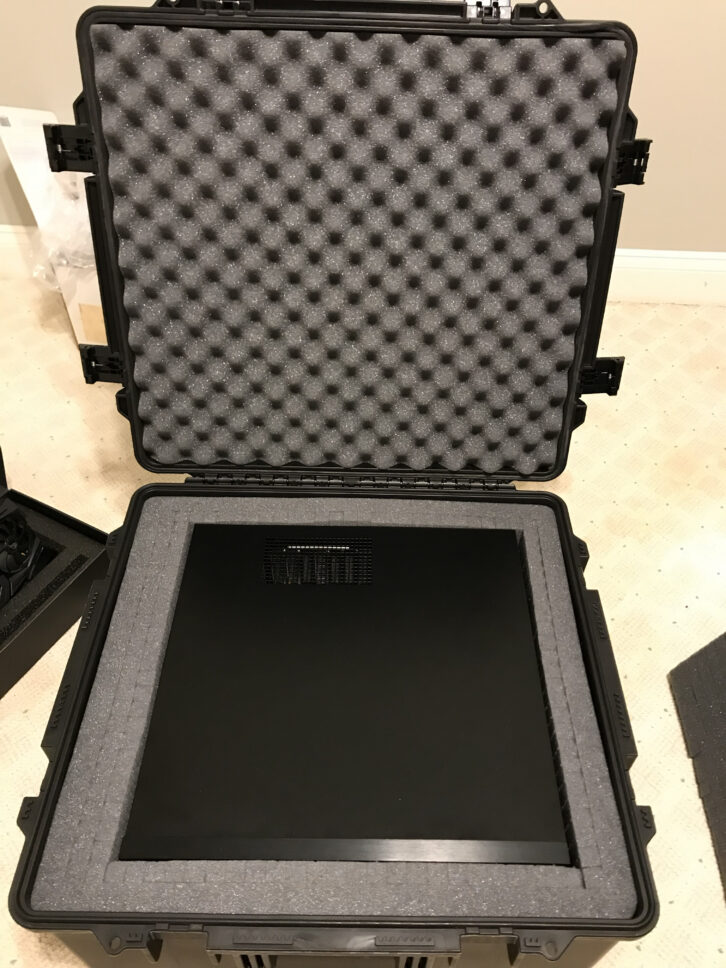
From the success at CEDIA Expo 2019, Litofsky and madVR Labs headed to ISE 2020, where they were invited by Alcons Audio to feature the Envy Extreme in its theater, which caught the attention of yet another major display manufacturer, among others. There was plenty of interest and a lot of buzz around the company — just in time for the world to shut down due to Covid.
However, when the world shut down, homes became more important, and demand for custom installation services skyrocketed. With its reputation growing, madVR Labs was in a good position to capitalize, until the global supply chain crisis made obtaining the Envy’s in-demand Nvidia GPUs hard to source.
“There were definitely challenges with producing units,” says Litofsky. “Neither Mathias nor I had much experience in sourcing components in large quantities, so we were learning a lot and figuring things out as we went along.”
Fortunately, the Envy’s capabilities are easy to demonstrate online, and the company used video meetings and produced educational videos so that once the supply chain crisis ended and models could ship, its dealers would be prepared.
madVR Today and Tomorrow
The Envy quickly took off as the user-friendly, next-generation, go-to video processor for luxury home theaters. It didn’t take long for integrators to give the company a wish list of features they wanted added, and the company responded with an onslaught of new features over the years that followed with free firmware updates, including instant aspect ratio, patent-pending non-linear stretch for both scope and 16:9 screens, subtitle management, updates to its now-patented Dynamic Tone Mapping, and MotionAI, the world’s first and only AI motion interpolation in a video processor with extreme control over the otherwise dreaded “Soap Opera Effect.” The company has kept its relentless innovation going on the hardware side, as well, introducing the initial Envy Core model last year for more modest budgets and new versions of existing models, as well as a few recently released brand-new SKUs.
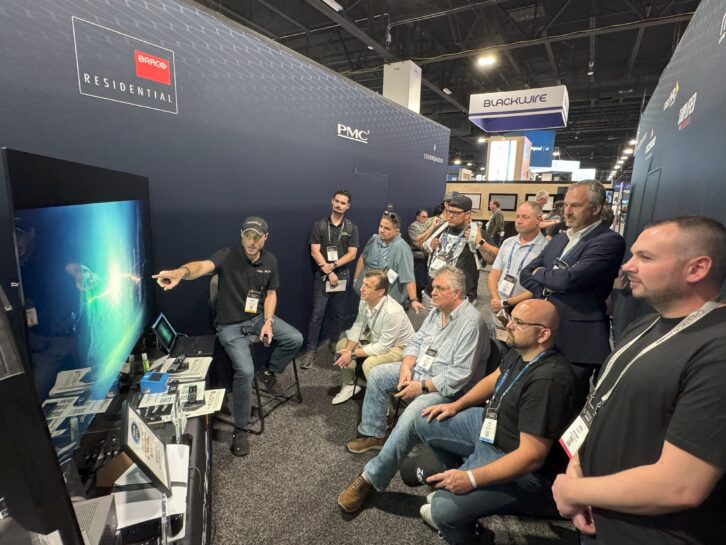
“We announced our third-generation products at CEDIA Expo 2025: the Envy Core MK2, the Envy Pro MK3, and Extreme MK3,” says Litofsky. “We kept the Envy Core MK1 as a current product and are still actively manufacturing it, because it’s a fantastic unit for customers who are not interested in HDMI 2.1 and a perfect fit for use with large screen TVs. We lowered the price to $4995 to make it more budget-friendly. The main difference between the Core MK2 and the Core MK1 is HDMI 2.1. We’re the first and only video processing company to come to market with a full 48 Gbps HDMI 2.1 solution, which means 4K120 4:4:4 12-bit gaming from a Sony PlayStation 5 and AI upscaling up to 8K60. It’s great for low-latency gaming with full VRR support up to 360 Hz on the output, which is something you couldn’t do on a video processor until now.
“The reason the Envy Core came in that evolution was that many of our integrators were saying, ‘Hey, the Envy Extreme is fantastic, and I use it in every theater, but I’ve got four or five other TVs around the house, and these could use an Envy also.’ They wanted something half the price, half the weight, and half the size — something they could hang on a wall or place in a cabinet. We exceeded that with the Envy Core, and we see a lot of integrators and enthusiasts using it with TVs to maximize immersion. That continues to be a hot market for us.”
The current madVR Labs lineup includes Core MK1, the Core MK2, the Pro MK3, and the Extreme MK3.
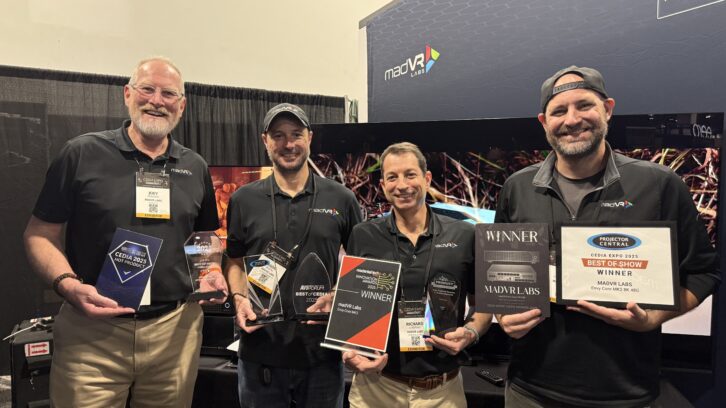
Despite all its success, madVR Labs has a relatively small team, which is surprising considering the number of products and updates it regularly supplies to its global audience of integrators.
“It’s been five and a half years since we started shipping, and we now have distributors and dealers in nearly 50 countries,” says Litofsky. “It’s fun and exciting to be able to share what we do. I think one of the keys to our success is that everyone in the company is super passionate about movies, home theater, and video quality. We live, breathe, and eat this stuff. The profits come along for the ride, but that’s not the primary driver. No, the primary driver is the passion and wanting these features for our own theaters and for our customers’ enjoyment. That’s what drives us to innovate like crazy and work so relentlessly. And none of this happened without our extraordinary team, the incredible support of our dealers, industry partners, and the loyalty of our customers, which we’re deeply grateful for.
Related: When “Good Enough” Won’t Cut It
“I’m quite pleased with our rate of innovation as well — we’re only five years in and on a third-generation product. Plus, we keep updating the firmware with free new features for our customers with previous-generation Envys. For instance, we recently rolled out an update that added low-latency gaming for all Envy models going back to our earliest units in 2020. We have a roadmap that’s got features on it like ‘AI motion compensated multi-frame noise/grain reduction’ and other really geeky, cool things. We’re also working on our patent-pending Dynamic Subtitle Overlay, which we’ve teased and shown at recent trade shows. Our customers are really excited about that, and people are asking every day when it is coming. And now that our new models are shipping, we’re back at it!”
Whatever the innovation, Litofsky is happy to be not only the CEO but one of the company’s most avid users himself. “At the end of the day, when I turn on my theater and sit down to finally watch a movie,” he concludes, “it always reminds me of why we do it.”
For more information — and to keep track of madVR Labs’ latest updates — visit https://madvrenvy.com/.