Lauren Lerner is the founder and principal designer of Living with Lolo, a nationally recognized Scottsdale, Arizona-based design firm that is known for creating refined, livable luxury. As both a full-service interior designer and licensed general contractor, she leads projects from concept to completion, blending design, construction, and furnishings into one experience. Her work spans custom homes and full-service remodels for clients across the country, including professional athletes and high-profile individuals.
Residential Systems recently sat down with Lerner for her perspective on working with technology and custom integrators as both a designer and general contractor.
RESIDENTIAL SYSTEMS: Can you provide a little background on your company and your history of working with custom integrators?
LAUREN LERNER: Living with Lolo is a full-service interior design and design-build firm specializing in high-end residential homes throughout Scottsdale, Paradise Valley, and Phoenix. Because many of our projects involve whole-home renovations or ground-up construction, we regularly collaborate with custom integrators to seamlessly incorporate lighting control, automated shading, whole-home audio, security, and smart kitchen systems. The key is bringing integrators into the process early, during architectural planning, so infrastructure, millwork, and sightlines are aligned from the start. That coordination ensures technology enhances the home’s function and livability without visually competing with the design.
The most successful projects are the ones where the integrator is treated as a core member of the build team, not an afterthought. That approach prevents costly retrofits and allows us to conceal wiring, panels, and equipment within custom cabinetry and wall assemblies.

At what phase of the design-build process do you prefer to bring in the technology integrator?
We prefer to bring the technology integrator in during the initial discovery phase, well before architectural plans are finalized.
When we are discussing how a client lives in the home, how they entertain, and what daily routines look like, that is when technology decisions should start taking shape. Early involvement allows the integrator to coordinate infrastructure, equipment locations, ceiling details, and millwork requirements before anything is drawn too tightly. It prevents last-minute compromises like awkward speaker placements, visible control panels, or cabinetry that has to be redesigned to house equipment.
Once architectural plans are solidified, changes become more expensive and more disruptive. Bringing the integrator in early ensures the technology feels seamlessly embedded in the architecture rather than layered on top of it.
Related: How to Change the Dynamic Between Interior Designers and Integrators
Integrators often talk in “specs,” while designers focus on the “psychology of space.” How can an integrator better translate their technical solutions into the emotional benefits you want for your clients?
Instead of leading with lumens, bandwidth, or processor speed, I encourage them to describe what the client will actually feel. For example, “This lighting system allows the kitchen to shift from bright and energizing in the morning to warm and intimate for dinner” is much more meaningful than a list of fixture capabilities. Or, “You will never see a wire, and you will not have to think about how anything works” speaks directly to the calm and ease we are trying to create.
Design is ultimately about how a space supports daily life. When integrators frame their solutions around comfort, simplicity, and atmosphere, it aligns naturally with the psychology of space. The technology becomes invisible, and the emotional benefit becomes the headline.
Considering that you focus heavily on the energy of natural light and the emotion of color, how do you view the role of automated shading and circadian lighting in your projects?
Automated shading and circadian lighting are tools that allow us to shape how a home feels throughout the day, not just how it looks in photographs. In the desert, especially, natural light is intense and beautiful, but it has to be managed. Automated shading lets us soften glare, protect furnishings, and maintain privacy without sacrificing the connection to the outdoors. Circadian lighting builds on that by subtly shifting color temperature and intensity from cooler, energizing light in the morning to warmer, calming tones in the evening. That progression supports how the body naturally wants to function, which makes the home feel intuitive and restorative.

The key is restraint. If the technology is noticeable or overly complex, it disrupts the emotional experience. When it is thoughtfully programmed and layered into the architectural lighting plan, clients simply feel better in the space without thinking about why.
What is the number one thing a custom integrator can do to make your life easier as a lead designer and general contractor?
The number one thing a custom integrator can do is communicate proactively and visually, not just technically.
As the lead designer and general contractor, I am managing sightlines, millwork details, ceiling conditions, and construction sequencing all at once. When an integrator provides clear reflected ceiling plans, equipment elevations, and coordination notes early, it allows us to resolve conflicts before framing or cabinetry begins. That level of clarity protects the design intent and prevents costly field changes.
The most helpful integrators anticipate how their systems impact trim details, ventilation, access panels, and cabinetry interiors. When they think beyond their scope and consider the whole room, it streamlines decision-making and keeps the project cohesive from concept through installation.
When a client is hesitant about the cost or complexity of home technology, do you prefer to lead that conversation yourself, or do you want your integrator to take the lead as the subject matter expert?
I prefer it to be a collaborative conversation, but I typically lead that conversation. As the lead designer and general contractor, I understand the client’s priorities, investment comfort level, and how they want the home to function. I frame the technology in terms of lifestyle and long-term value, then bring in the integrator to walk through the specifics. That sequencing keeps the discussion grounded in the client’s goals rather than turning into a technical presentation.
When cost or complexity feels overwhelming, it is usually because the benefits have not been clearly tied to daily life. The most effective integrators simplify the explanation, outline phased options if needed, and focus on reliability and ease of use. Clients are far more confident when they understand what they are gaining and how seamlessly it will operate.
As a firm that provides white-glove service, your reputation is on the line with every trade you recommend. What are the “red flags” that would make you stop working with a specific technology partner?
The biggest red flag is a lack of accountability. In a white-glove environment, responsiveness and follow-through matter just as much as technical skill. If an integrator misses coordination meetings, delays drawings, or blames other trades instead of collaborating on solutions, it creates friction that clients feel immediately. Another concern is overpromising on performance or timelines. In luxury residential work, expectations are high, and credibility is everything.
I also pay close attention to how they communicate with homeowners. If explanations feel overly technical, dismissive, or sales-driven, it erodes trust. The right technology partner understands that they are an extension of our brand and treats the client experience with the same level of care we do from concept through final walkthrough.

You’ve warned against homes that are “too tech-heavy.” Can you give an example of a smart home feature that you think has crossed the line from being a luxury to being a nuisance? Also, the flip side: What tech do you now see as a “must” in your designs?
A common example is over-automation, where every light, shade, and appliance is tied to complex scenes that the homeowner cannot easily override. When a client has to pull out a phone or remember a sequence just to adjust a single fixture, it stops feeling like a luxury and starts feeling like a system they are managing. Technology should reduce friction, not create it.
On the flip side, thoughtful lighting control and automated shading have become essentials in our projects, especially in Arizona. Layered lighting that can shift intensity throughout the day and motorized shades that respond to sun exposure protect finishes, improve comfort, and quietly support how the home functions. When these systems are intuitive and minimally visible, they enhance daily life without competing with the design.
What are your biggest frustrations and biggest opportunities when it comes to integrating tech into outdoor entertaining spaces?
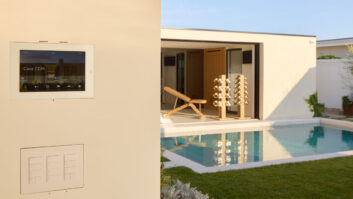
The biggest frustration with outdoor technology is when durability and design are not considered together from the start. In Arizona, extreme heat, dust, and monsoon conditions are real factors. I have seen beautiful outdoor living spaces compromised by visible conduit, poorly scaled speakers, or screens that cannot withstand direct sun. When technology is value-engineered too late or specified without understanding the climate, it affects both performance and aesthetics.
The biggest opportunity is creating seamless indoor-to-outdoor continuity. Discreet landscape audio, glare-resistant displays, integrated heaters, and automated shading can extend the usability of a space well beyond sunset or peak heat hours. When these systems are coordinated early with architecture and millwork, outdoor entertaining feels effortless rather than like a separate zone that requires its own learning curve.
When an integrator wants to partner with you, what should they show you to prove they understand what you are looking for?
I want to see detailed coordination drawings, clean installations, and examples where speakers, keypads, and panels are thoughtfully aligned with architectural elements. Photos that demonstrate restraint are powerful. Show me how equipment was concealed within millwork, how ceiling layouts remained balanced, and how exterior technology blends into landscaping. That tells me they understand proportion, sightlines, and materiality.
It is also helpful when they can articulate the client experience, not just the system components. If they can explain how they simplified controls, reduced visual clutter, and supported the way a homeowner actually lives, that signals we share the same priorities.
Related: The Design Whisperer
If you could give the integrators one piece of advice on how to build a strong partnership with a top-tier design firm like yours, what would it be?
Take the time to understand the aesthetic language of the firm, how we document projects, and how we communicate with clients. When an integrator aligns their drawings, timelines, and client conversations with our process, it creates a unified experience. Consistency builds trust, and trust is what allows us to confidently bring a partner into high-level projects.
The strongest relationships are built on anticipation. If you can foresee coordination challenges, propose solutions before they become problems, and protect the client experience at every stage, you become indispensable to the team rather than interchangeable.
For more information, visit www.livingwithlolo.com.