For decades, the residential AV industry has operated under a core assumption: high-fidelity audio requires dedicated square footage. If a client wanted immersive audio, the conversation naturally steered toward architectural in-walls, floor-standing towers, or a dedicated soundbar. Embedded audio — sound built directly into a consumer product — was historically dismissed as a design compromise, a checkbox feature that sounded relatively good for, say, a projector, yet lacked the acoustic muscle to challenge a standalone system.

That paradigm is now shifting. In recent years, embedded audio has evolved from a localized component add-on to a legitimate, system-level design discipline. Today, manufacturers are engineering high-fidelity audio into form factors that were never originally designed around acoustics, from portable projectors to lighting fixtures and connected furniture. For residential integrators, this represents a largely untapped value proposition: offering clients an entirely new category of zero-footprint, high-performance luxury.
Engineering the Tight Quarters
The greatest obstacle to creating great sound — volume constraint — comes down to simple physics. In the traditional audio world, larger enclosures provide the breathing room required for deep bass extension and dynamic range. At Harman Embedded Audio (HEA), a 40-millimeter loudspeaker is standard issue. For the rest of the audio industry, it barely registers as a driver.
To deliver room-filling sound from an enclosure that small, our approach relies heavily on an early co-design framework with our original equipment manufacturer partners. If mechanical engineering is locked before acoustics are considered, the audio team is forced to spend its time compensating for limitations rather than optimizing performance.
Related: Sound Investments
When brought into the product development cycle early, we treat the entire product as a complete, unified acoustic system. When brought in late, we rely on a sophisticated combination of micro-transducer selection, predictive acoustic modeling, and proprietary digital signal processing to simulate the acoustic volume the physical chassis lacks. The goal is to transform the box itself into a tuned acoustic instrument.
The Science of Scale
Tuning such as this requires moving away from a single, rigid target curve. You cannot tune a portable projector the same way you tune a luxury home theater tower. Instead, we anchor our engineering in a shared psychoacoustic framework, a set of foundational guiding principles developed over decades at Harman.
Over the last decade, our engineering teams have meticulously documented performance specs for effectively every practical enclosure size.
Embedded vs. External: The Spatial Value Case
When framing this for a client deciding between an embedded audio product and a separate soundbar, the conversation shouldn’t be about spec-sheet parity. It’s about space efficiency, portability, and lifestyle integration.
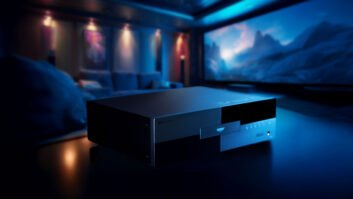
Consider a small projector that features a compact 6-watt system, yet it delivers surprising clarity in the mid and upper-mid ranges — the exact frequencies where human dialog and content comprehension live. For an urban apartment, a bedroom, or compact living spaces, a massive soundbar footprint simply isn’t a viable option.
Looking slightly ahead, the true future-facing story for integrators is how embedded audio will solve the aesthetic approval hurdle entirely. HEA is actively developing advanced wireless connectivity architectures that will allow these unconventional form factors to seamlessly integrate into a wider, distributed residential ecosystem. When that work is complete, imagine a client’s living room where a pair of architectural lamps serve as the front left and right channels, while a wireless mini subwoofer hidden under a chair handles the low-frequency effects. The client gets a genuine 2.1 or greater cinematic experience, and the room remains entirely free of visible wires and black boxes.
Managing Heat and Vibration
Integrating speakers into tight quarters with advanced electronics brings up another major engineering hurdle: thermal and mechanical management.
Fortunately, modern portable solid-state projectors run significantly cooler than legacy lamp-based units. However, when we integrate audio into set-top boxes running heavy system-on-a-chip (SoC) processors under Android or Linux architectures, heat is a major threat to acoustic performance.
To mitigate this, HEA utilizes creative mechanical strategies. In sealed enclosures, we configure our speaker and woofer cones to act as internal fans to circulate air and cool hot internal components. We also implement strategic physical air-gapping, protective plastic thermal shielding to separate transducers from heat zones, and deep DSP-based thermal protection algorithms that prevent micro-transducers from over-modulating or overheating during prolonged, high-output use.
Pushing the Boundaries of Form
To see where this category is heading, consider two recent integration examples that illustrate where the category is going: furniture and tablets.
Connected furniture presents a fascinating paradox. Because a sectional sofa is massive, it offers incredible acoustic freedom and volume for large speaker boxes and a subwoofer built directly into the seat frame. The challenge, however, is human geometry. The speakers are embedded at armrest level — beside the listener rather than in front of them. To solve this, our engineers utilized extensive DSP filtering and soundstage manipulation to artificially bend the audio wave, steering the acoustic image so that the listener experiences a genuine, perfectly staged front-left and front-right home theater experience.
Related: Ask the Interior Designer
On the absolute opposite end of the size spectrum sits a tablet. An affordably priced tablet features an incredibly thin chassis, yet it houses a rear-facing multiple-driver array. Through meticulous mechanical tuning and signal processing, this system produces a level of loudness and acoustic clarity that well outperforms what the chassis suggests is possible. It is a definitive proof: The tighter the mechanical constraint, the more embedded engineering matters.
Resolving the Wireless Blind Spot
The ultimate success of embedded audio in the residential space hinges on a critical, often unsexy challenge: wireless stability. Industry-wide, Wi-Fi-based audio protocols frequently suffer from fragile setup experiences, lengthy time-to-sound latencies, and unreliable firmware updates.
Because consumers and OEM partners possess widely varying levels of technical infrastructure — ranging from teams with full user-experience specifications to brands requiring ground-up architectural guidance — systems must be bulletproof out of the box. Harman’s deep, system-level understanding of these complex network and firmware layers ensures that our embedded systems don’t just sound excellent in a pristine lab setting; they deploy reliably, maintain stable connectivity, and function flawlessly in the unpredictable wireless environments of the real world.
For the residential integrator, embedded audio is no longer an afterthought or a compromise. It is a sophisticated, invisible system discipline that allows you to capture spaces where traditional audio gear simply cannot go.