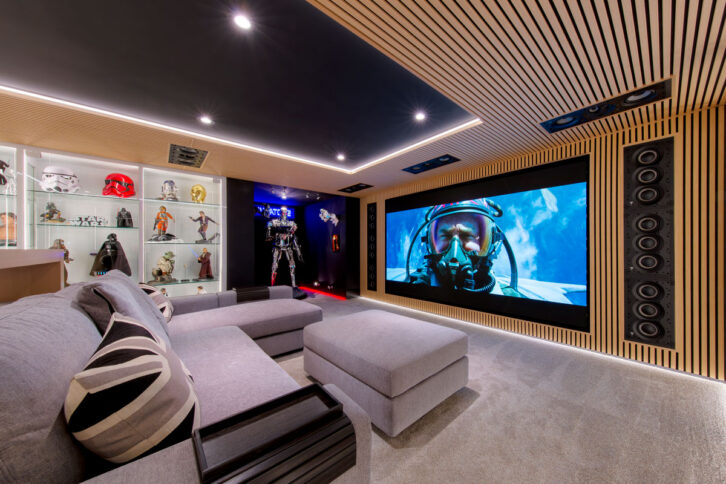
We had a client come to us in February 2026 on a referral. Their basement already had a home theater in it, a basic projector and ceiling speaker package with a picture that was only viewable with every light switched off, and they were ready for something built to a completely different standard. The room was also about to take on a second role. The homeowner has been collecting movie memorabilia since 2017, and the plan was to consolidate all of it — Star Wars, Batman, Marvel, DC, Rambo, and a life-sized Terminator T800 — into custom-lit cabinets on three walls of the theater.
“We wanted to be able to watch a movie and see the figures at the same time,” the client told us. “That is what led us to the video wall, and we obviously needed a sound system that was comparable.”
Power Week: The Difference Between PoE and Distributed DC
The brief was a huge, immersive image and immersive sound with the cabinet lighting left on. That pointed us away from front projection, which is at its best in a dark room, and rear projection needs throw depth that the basement could not give. A Micro LED video wall proved the right answer, so we specified a custom 136-inch Just Video Walls display, sized to the last inch the ceiling height would allow. The moment that decision was made, electrical requirements became just as critical to the project as the AV system itself.
A video wall adds a big power draw — it is a wall of driver electronics with its own power supplies, sharing a rack and a signal chain with a surround processor, two amplifiers, a video processor, and a 24-port network switch. The load goes up, and so does the noise sitting on the circuit.
We do not build a large system without a Torus Power unit in it. Part of the reason is upstream of the house, where the supply itself is getting less stable. Regional demand forecasts have electricity use growing roughly 20% by 2030 and 50% by 2050, with peak demand up 44 percent, on a grid whose backbone was built between the 1960s and the 1980s. Heat pumps, EV chargers, rooftop solar, and LED drivers all live on the customer side of the meter, and every one of them puts something back on the line. A grid running closer to its limits hands the house more severe peaks and dips, and that is what the Torus is there to absorb. It regulates what reaches the rack, so the electronics never see the swing.
Power Week: Lighting the Way
The rest of the argument has nothing to do with the grid. Most of the noise in a system this size is generated inside the system by every switching supply in the rack, from the streaming box to the network switch to the wall itself. Any of it can land on the circuit feeding your processors, and you will hear it and see it. So, on this build we designed the power distribution first and let the electronics follow.
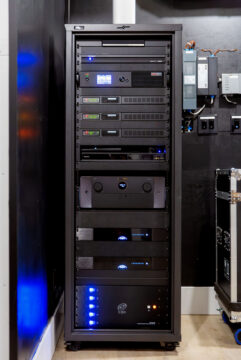
Five Balanced Circuits Off One Toroid
We specified the largest rack-mounted unit Torus Power makes, the RM100BAL — a 240-volt balanced input, 120 volts out at up to 100 amps, and 12,000 VA through 24 medical-grade Hubbell outlets. One hundred amps is more current than a lot of houses are wired for. The balanced input does real work, with the two input phases 180 degrees out of phase so common-mode noise cancels ahead of a massive toroidal transformer that is already providing true isolation, narrow bandwidth filtering, and series-mode surge protection. The same toroid delivers instantaneous current on demand, which matters when six in-wall subwoofers ask for it at once.
From that one chassis we ran five isolated, fully balanced 20-amp circuits, assigned by function rather than by convenience. The video wall is on its own, the amplifiers are on their own, the processor and the source components share one, and the network equipment is on its own. The wall got its own circuit because it is the biggest load in the room and the largest single source of switching noise. Isolated, its noise never reaches the surround processor or the amplifier inputs, and it still draws whatever it wants. A large part of why the image looks the way it does is that the power behind it is clean. That is the decision from this project I would carry into every video wall job we do.
What Clean Power Bought Us
The image out of this wall is exceptional, and the shot everybody comments on is streaming straight off Prime Video. A Lumagen Radiance sits ahead of the Just Video Walls processor. Put processing like that behind clean, isolated power and a streamed source, and it holds up at 136 inches.
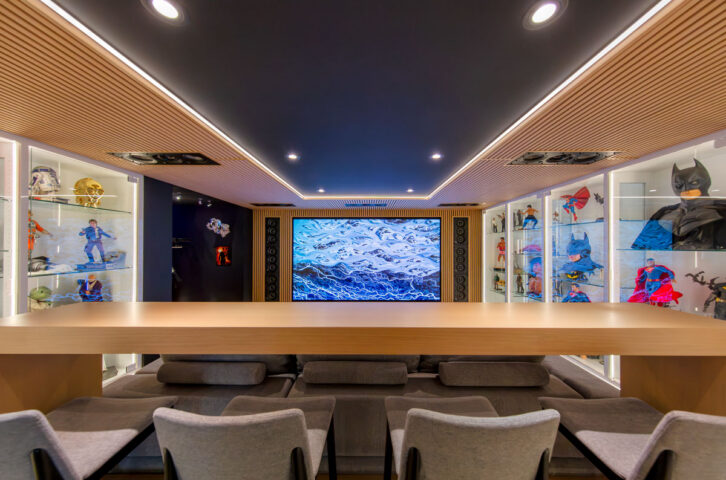
Clean power also buys a calibration worth keeping. With all seven main channels in the ceiling, we did a full Dirac Live Active Room Treatment session. The before-and-after frequency response barely moved, because the room was already acoustically excellent. The value was in how ART handles delay and crossover behavior and in using the other speakers to actively cancel an anomaly in one of them rather than equalizing it away. It does not sound like 13 speakers each doing their own thing. It sounds like sitting inside a dome of sound.
Everything Else Followed
A video wall leaves nowhere behind the screen for speakers, and this one is tall enough that a center channel above or below it would have cost us image size, so all three front channels went into the ceiling with the surrounds. Seven identical Focal 1000 Series in-wall models cover left, center, right, sides, and rears. The mid-range and tweeter pod rotates in the housing, so every one is aimed at the listening position instead of firing straight down. When I proposed leaving the grilles off, the clients said to not cover those up. Six Focal 1000 in-wall subwoofers flank the screen with 6-inch drivers that hit far harder than they look.
Three walls of lit glass cabinets were the acoustic problem. We worked with the cabinet maker to build cases stiff enough that nothing inside them moves or rattles at any volume, then handled reflections with a custom acoustic slat wall, thick carpet, and custom fabric furniture, leaving the center of the ceiling untreated so it did not go dead.
The screen wall itself was built by the homeowners’ contractor, Wildwood Projects of Chilliwack, BC, to Just Video Walls’ installation checklist. The JVW installer who flew in from Calgary called it the flattest, straightest wall prep he had ever seen, which on a screen this size is exactly what you are seeing when the panels line up perfectly. Wildwood also built in air intake slots below the wall so the panel electronics breathe into the plenum with no visible vent.
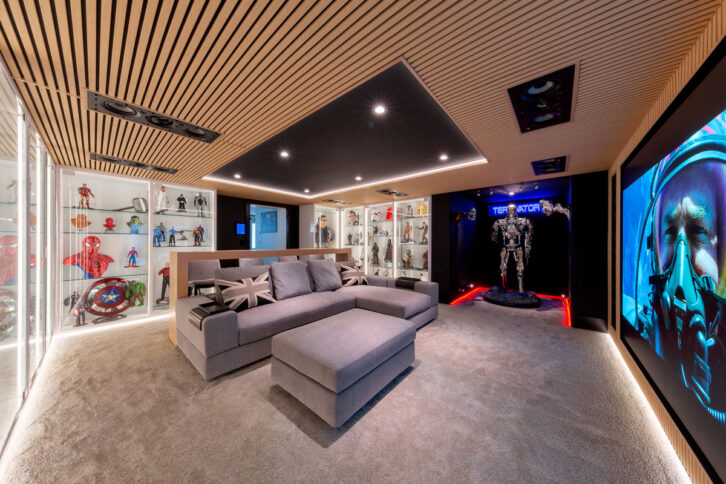
The electronics on those five circuits followed the same logic. Processing is a Marantz AV30, amplification a pair of Naim CI-NAP108s, chosen because Focal and Naim are sister brands and these amplifiers were engineered to work with these architectural speakers. Control stayed simple: an RTI remote with a docked iPad, and our team helped program the builder’s scenes, including a movie preset that leaves a lightsaber glowing in the cabinets.
Power Week: The Power Is in the Details
There was one hard deadline on this job, the opening kickoff of the World Cup on June 11. We finished on June 9. The homeowners watched the tournament on the new system with the whole collection lit behind them, and soccer is still what the room gets used for most.
They trusted us to design the whole thing and gave us the room to do it, and the reaction has made that worth it. “We absolutely love our new room,” the homeowner says. “It’s beyond our expectations.”
What I Would Tell Another Integrator
Design the power first, because the electrical plan is a design input, not a punch-list item. Size the isolation unit for what the wall asks for at switch-on, not for what it averages. Give the display its own isolated circuit, so the noisiest load in the room stays out of the audio chain. And get all of it onto the drawings before the electrician does rough-in.
For more information, visit hificentre.com and toruspower.com.
Equipment List
- Video Wall: Just Video Walls 136-inch Custom Video Wall [1]
- Video Processor: Lumagen Radiance [1]
- Surround Processor: Marantz AV30 [1]
- Power Amplifier: Naim CI-NAP108 [2]
- In-Wall/Ceiling Speaker: Focal 1000 IWLCR6 [7]
- In-Wall Subwoofer: Focal 1000 IWSUBUTOPIA [6]
- Power Isolation Unit: Torus Power RM100BAL [1]
- Control: RTI Remote + iPad App (iPort dock)
- Networking: 24-Port Network Switch
- Cabling: Transparent & AudioQuest
- Acoustic Treatment: Custom slat wall with integrated acoustic foam
- Calibration: Dirac Live Active Room Treatment