Ed Bonisch knows shades. He started his company, Brading Specialty Shades, in Toronto in 1979, just one year out of high school. (Brading was the name of his favorite beer at the time, now discontinued, but he liked how it sounded as a business name — plus, the seven letters made it easy to use for 800 numbers.) Today, the company has thriving shading retail, wholesale, and fabrication businesses.
“I started with a product called Window Quilt, which was out of Brattleboro, Vermont,” says Bonisch. “Window Quilt was an energy-efficient shade that fit in sidetracks. It looked awful — like you’re living in a padded room — but it worked. It was equal to four layers of glass, and the tracks had to be installed perfectly plumb. They had to be parallel, and you had tolerance of about an eighth of an inch. It was very good training.”
It did not take long for Brading to start what it would soon become known for: modifications. “We came up with a modification for a skylight where we could take a Window Quilt and modify it to work on an angled application,” he remembers. In the ‘80s, Brading sold Hunter Douglas shades and became the number one specialty skylight dealer. “The skylights led to straight sunroom installations, which led to a curved Four Seasons sunroom that continued to advance our focus in specialty applications,” explains Bonisch.
Close to 20 years ago, Brading became the number two Lutron dealer in Canada, after securing a recommendation from the number one dealer. “Once they went tubular with their motorized shades, I lost a $30,000 job to a young kid with barely any experience,” he recalls. “Two months later, I lost another job. A month after that, I lost a third job to a home automation company that didn’t have a clue about shades. That’s when I reached out to Lutron and said, ‘Hello, my name is Ed. Can I set up an account with you?’”
While Brading does installation and programming, it has found greater success at being the shade expert for residential integrators, with CI dealers bringing Brading into their projects.
“Custom installers have used us for turnkey solutions,” says Bonisch. “You can see they’re dipping their toe in the lake and thinking that they should try it themselves because they’re going to make a lot more money when they do it that way. My wholesale company is encouraging that. It’s not a matter of saying, ‘Farm it out to the retail company anymore.’ We will come in and train you, and we’ll teach you how to do this and make a good margin.”
In fact, Brading is so interested in helping regional dealers that, if they mismeasure their shades and they are too wide, Brading will cut them to the proper size at their fabrication facility, saving the dealer a lot of time and maybe even face with their client.
Related: Lutron Releases 2026 Luxury Residential Trend Report
“For a service fee of $225 Canadian, we stop what we’re doing and cut down the shade while they wait,” says Bonisch. “Now, while we’re cutting down that shade, my son-in-law Dave is saying, ‘Come into our showroom and let me show you what we do.’ It’s just a good opportunity for us because we don’t want to be everything to everyone. We just want to be the shade niche guys.”
Bottoms Up
Brading’s interest in modifications has led to the creation of Laudations, which is a specialized bottom-up, motorized shading system that allows for wire-free views of the outdoors.
“We’ve been working on Laudations for seven years, and it is trademarked,” says Bonisch. “With many bottom-up shades, there are visible cords, but we’ve come up with a hardware system without them. We built a tubular transmission that is creating a box motor. Box motors are not unusual, but we’ve been working to develop a much higher quality one using a Lutron drive. We saw quite early that there was a need for a good bottom-up shade without cords, without wires, without strings, and without a rail at the top. That is what Laudations is.”
Laudations incorporates small aluminum sidetracks and internal drive belts coupled with polycarbonate return pulleys to raise the shade to the desired height and privacy from a hidden pocket below. The 7/8- x 7/8-inch sidetracks are surface-mounted or recessed into the sides of the window frame for an unobstructed view. The shade can be operated through a wall switch, wireless remote control, or integrated into a third-party automation system for central control.
A Laudations shade can be used on windows from 24 to 84 inches wide and up to 120 inches in height. It is available in a wide variety of fabrics and colors, and uses a quiet 24-volt DC motor that draws power through a discreet wire that can be embedded into the wall in new construction or run along the window frame and baseboard for retrofit construction.
“For non-rectangular applications, there’s no other option — you have to use cords — but for rectangular applications, this is an interesting product,” adds Bonisch. “We have numerous modifications — I think we’re on revision 18 — but we now have a 3:1 transmission, which allows our system to come up from the bottom at the same speed as a typical 150 or 100 that’s dropping down from the top.”
Shade Project of the Year
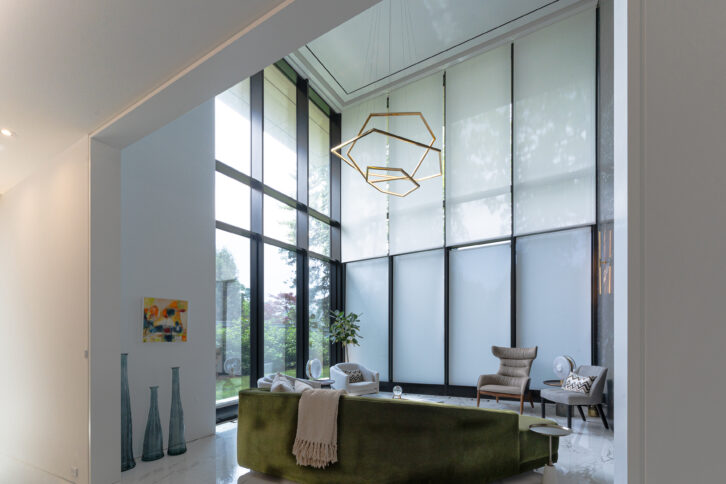
That upper/lower speed-matching feature came in handy for a recent Brading project, one that won it Lutron’s Best Shading Project in 2025. “The project was done with a Laudations system using a Lutron QS150 custom transmission, Brading ingenuity, and high-quality European components,” says Bonisch.
Up top, in addition to the top-down shades, Brading had installed a curtain track that has a toothed belt that goes around a return pulley and comes back down and then joins together with the shades. “So, you have this curtain track belt on the right and left. The transmission that we created drives two quarter-inch hex shafts simultaneously that go into the drive of the two tracks. Where the belt comes together, there’s a connector, and that’s normally the bottom bar, but in this case it’s the top bar.
“For the bottom, the Lutron shades are going to go up, come down, and stop in any position. The key now is how do we get the fabric to be nice and tight like a drum. We’ve been working on this for seven years. I have a spring that I’ve worked with since the late ’80s, and we have a spring-loaded roller blind at the bottom where we deactivate the locking feature. Basically, the shade lifts, and the spring wants to pull it back. It’s an interesting balancing act between the torque of the motor and the spring, because as the motor lifts the fabric higher, it has to work harder because the spring wants to pull it back with more force. It’s a real balance. That’s the magic to this system — we knew the fabric had to hang just as well as the gravity drop shades from the top.
“We used our rev 14 transmission, and it was slow, so we came up with a new version, and we finally had the bottom-up shades running at the same speed as the top-down.”


The project included six 60- x 144-inch windows to be covered — three one-on-ones facing south and two two-on-ones facing west. “He’s facing the street, so the client wanted privacy,” says Bonisch. “Hence, the whole point of bringing up the shades, and you don’t have to go all the way up to 10 feet. We also put a lot of thought into seasonal control because he has expensive furniture and artwork that needed protection from the sun throughout the year. We wound up with four zones: upper south, lower south, upper west, and lower west. There’s a Lutron HomeWorks system in place with a third-party overlay for control.”
Rolling On
At 67 years old, Bonisch is looking to begin phasing out his role at the company. He has a partner that is moving the company toward more programming, which he is all for, but maintains his love for working with integrators on all things shading.
Related: The Shade Partner Checklist
“In my remaining days in the industry, I simply want to grow the wholesale, and I want to grow dealers,” he concludes. “I want to teach them what I know and come up with really challenging solutions, because if someone has a 7-foot arch and I can solve that, then I’m going to get the whole house.”
For more information, visit brading.com.