There comes a point in a client’s journey where the conversation changes in a fundamental way. Prior projects are, by nature, iterative. A media room becomes a better media room. A dedicated cinema evolves into something more refined. Each project captures lessons, preferences, and a progressively deeper understanding of what truly matters. Eventually, however, the question shifts. Not “what can we improve?” but “what must this be forever?” The client is no longer pursuing better. They are seeking finality. Resolution. They are ready to create their ultimate private cinema. The one that fulfills every expectation shaped by a lifetime of experience. Their Forever Cinema.
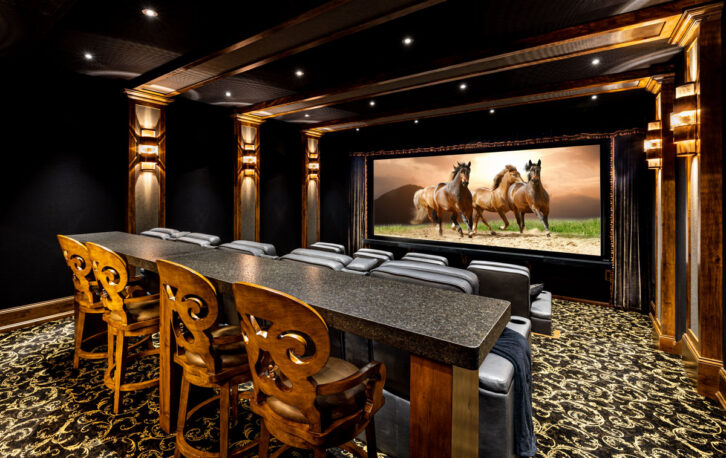
This concept is not rooted in excess. It is rooted in permanence. It represents the culmination of every success and every shortcoming encountered along the way. It is the project where compromise is no longer acceptable, particularly in areas that cannot be corrected later. It is deeply personal. This room is not designed for resale value or broad appeal. It is designed for a life well lived.
The Buffalo Run Private Cinema serves as a valuable reference point in understanding this mindset. It reflects a disciplined commitment to fundamentals, engineering integrity, and a level of execution that anticipates long-term performance rather than short-term impression. A Forever Cinema builds upon that philosophy and extends it to its ultimate conclusion.
Lessons Carried Forward
No client arrives at a Forever Cinema without history. That history is not incidental. It is the most valuable design input available. Through prior projects, clients discover what truly moves them. They learn their sensitivity to noise floor. They recognize that seating ergonomics matter deeply after hour two of a film. They understand whether image scale enhances immersion or introduces fatigue. Just as importantly, they learn what they cannot live with again. Mechanical systems that intrude. Isolation that falls short. Layouts that seemed right in concept but feel subtly compromised in use. Those lessons are not suggestions. In a Forever Cinema, they become non-negotiable constraints.
If a previous room suffered from mechanical noise, the new room is engineered with uncompromising isolation and remote system placement. If bass performance lacked uniformity, low-frequency control is addressed comprehensively from the outset. If seating geometry felt less than ideal, the new layout is calculated with precision. The fundamental shift is this: The Forever Cinema is not exploratory. It is declarative. It defines, with clarity and conviction, what the room must be.
What Cannot Be Fixed Later
There is a clear hierarchy in cinema design. Some elements can be adjusted after completion. Many cannot. At the top of that hierarchy is build quality. Structural decisions define the acoustic and performance potential of the room. Wall assemblies, floor construction, and ceiling systems determine isolation, rigidity, and resonance behavior. Once built, these characteristics are effectively permanent.
Quiet room construction is equally essential. A low noise floor is not a luxury. It is a prerequisite for true dynamic range. As clients age, this becomes increasingly important. Older listeners often exhibit reduced tolerance for competing noise, even as hearing thresholds shift. Mechanical systems must be engineered to operate below audibility. Disciplined duct design, low-velocity air movement, remote equipment placement, and comprehensive vibration isolation are not refinements. They are foundations.
Also by Sam Cavitt: Excellence by Design
Engineering excellence must extend across all systems. Loudspeaker placement must be coordinated with structural framing. Screen selection must align with projection performance and room geometry. Accessibility is another consideration that must be addressed early, and without compromise. Entry paths, aisle widths, and circulation must anticipate future mobility needs. Riser heights and floor transitions must allow for adaptation. In some homes, an elevator is not an upgrade but a necessity. These are not aesthetic decisions. They are foundational. They determine whether the cinema remains fully functional and comfortable for decades.
Designing for Changing Senses
A Forever Cinema acknowledges an unavoidable reality: human perception changes over time. Hearing acuity declines, particularly at higher frequencies. The appropriate response is not to artificially brighten the system. Excessive high-frequency emphasis leads to fatigue. The objective is balance. An acoustical environment that preserves clarity, intelligibility, and natural tonal character. Room acoustics are central to this goal. Poorly controlled reflections and excessive reverberation reduce intelligibility, and that issue becomes more pronounced with age. Dialog clarity must remain intact and effortless at all listening levels. Low-frequency performance requires equal attention. A properly engineered system with uniform spatial response ensures consistent, controlled impact across all seating positions.
Visual acuity follows a similar trajectory. Contrast sensitivity declines. Brightness perception shifts. These changes elevate the importance of video system design. Projection must deliver adequate luminance without sacrificing color accuracy. Screen size must be selected with restraint and discipline. Larger is not inherently better. The image should fill the viewer’s field of vision comfortably, without inducing fatigue during extended viewing. High dynamic range can enhance the experience, but only when properly implemented. A well-calibrated system preserves nuance across the entire dynamic range. That nuance is what makes a room worth returning to.
Ergonomics must not be overlooked. Seating must provide proper support over long durations. Consider lumbar support, head alignment, ease of ingress and egress. Control systems must be intuitive and accessible. Fatigue is cumulative. Small inefficiencies become significant over time.
Environmental Engineering
Comfort is not secondary to performance. It is inseparable from it. Air quality has a direct impact on both health and perception. A poorly ventilated room diminishes the experience. A Forever Cinema incorporates dedicated ventilation that delivers fresh air silently and continuously. Temperature control must be stable and precise. Cinemas generate significant heat from equipment and occupants alike. Systems must be properly sized and zoned to maintain consistent conditions without introducing noise. Humidity must also be managed. Imbalances affect comfort, material longevity, and equipment reliability. These are engineering considerations with direct consequences for the audience experience.
Lighting design must balance safety and immersion. Step lighting, indirect illumination, and task lighting must be carefully integrated. Control systems should allow seamless transitions between functional and presentation modes. The room must serve all of life’s moments, the casual and the cinematic alike. And it must do so gracefully, without friction.
A Room for a Lifetime
A Forever Cinema is not defined by its specifications. It is defined by how it supports life. There is an emotional dimension that no specification can capture. Over time, a cinema becomes associated with memories. It becomes part of a family’s story. The room where grandchildren experience cinema for the first time. Where friends gather for something that lingers past the credits. Where shared moments become the ones worth remembering. A Forever Cinema embraces this. It becomes an integral part of the home’s identity.
Also by Sam Cavitt: Navigating the Private Cinema Evolution
The design must accommodate these experiences. Seating should support varying group sizes without compromising the primary listening position. Circulation must be effortless. The space should feel welcoming, never formal or restrictive. Materials and finishes must reflect the client’s sensibilities while preserving acoustic integrity. This is not decoration. It is cohesion. Every element contributes to a unified, enduring environment. Rooms that get this right don’t just perform. They resonate. We all know what it feels like to be somewhere that just “fits.” That is the goal.
The Final Iteration
A Forever Cinema is not an experiment. It is the result of accumulated knowledge, executed with precision and disciplined intention. Every decision must be evaluated through the lens of long-term performance. Compromise in critical areas is not acceptable. Many of these decisions simply cannot be revisited. It also requires complete alignment between client and designer. Expectations must be clearly defined. Priorities must be established early. Communication must be precise and continuous. Both parties must share the conviction that this room deserves their best.
When properly realized, the result is a room that does not call attention to itself. It simply performs. It supports the content. It supports the client. It remains relevant, comfortable, and deeply satisfying over time. Its success is not measured by its initial impression, but by its consistency, day after day, year after year. That is the measure of a room built not for right now, but for a lifetime.
Conclusion
The Forever Cinema is, ultimately, an investment in experience. It is the convergence of architecture, engineering, technology, and human understanding. Brought together to create something enduring. A private cinema that fulfills every expectation shaped over a lifetime. A space that continues to delight, to engage, and to create meaningful moments for the client, their family, and their friends.
Not simply a final project. A lasting one. Their Forever Cinema.