Direct-view LED (dvLED) video walls deliver massive, seamless images with exceptional brightness and contrast without requiring a perfectly dark room. At the same time, they eliminate one of the greatest advantages of traditional projection systems: the ability to position the center-channel speaker directly behind an acoustically transparent screen. Without that option, dialog no longer naturally appears to originate from the actors on screen, forcing integrators to rethink how they create a convincing front soundstage.
Manufacturers and theater designers are addressing this challenge through a combination of digital signal processing, psychoacoustics, engineered loudspeaker placement, acoustic design, and meticulous calibration. There’s no magic formula, but when audio is considered from the earliest stages of system design, the results can be remarkably realistic.
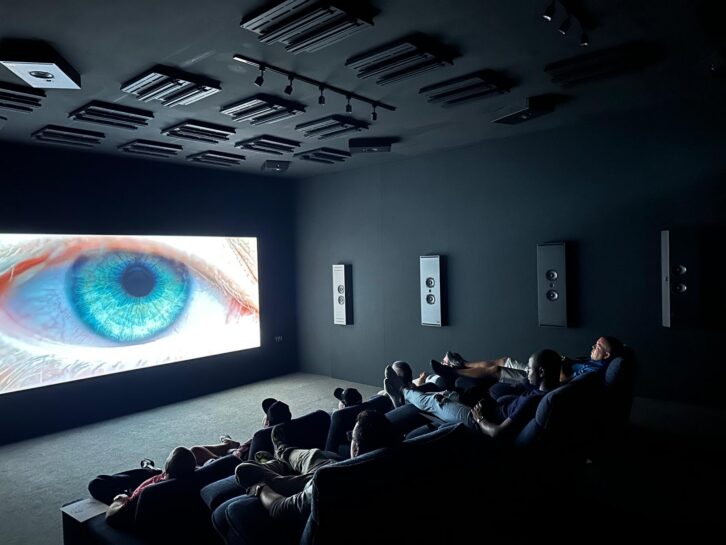
“There are a lot of challenges with video walls in home spaces, and it is a very misunderstood topic,” says Ryan Donaher, owner of Apex Technologies-US, the U.S. distributor for Meridian Audio and TPI Aerospace, among other brands. “As the anchor of a surround-sound configuration, the center channel deserves careful consideration and execution that truly keeps dialog connected to the picture.”
There are several ways to achieve this effect:
Use DSP to Elevate the Center Channel
Digital signal processing uses mathematical filters and timing adjustments to control the phase, frequency response, and arrival time of sound. In dvLED applications, DSP can leverage psychoacoustic principles to influence where listeners perceive dialog to originate.
Home Theater Week: Unlocking Professional Audio Precision
Meridian Audio accomplishes this with a proprietary technology named “Image Elevation.” Designed for projects where speakers must be located beneath a large display, the processing raises the perceived location of voices so they sound more closely aligned with the on-screen action. Rather than physically relocating the loudspeaker, Image Elevation alters how sound reaches and is interpreted by the listener, minimizing the disconnect between a low-mounted speaker and the image above it.
DSP, however, has its limits. “We’re certainly going to see more adoption of DSP to compensate for the consequences of loudspeaker placement, but it’s not a single easy fix,” says Donaher. That’s why manufacturers are also exploring solutions that address the problem through loudspeaker design and placement, rather than relying on processing alone.
Apply Loudspeaker Geometry to Create a Phantom Center
TPI Aerospace approaches the center-speaker challenge differently. Its Movement loudspeaker configuration positions matched speakers above and below the dvLED wall, creating a blended acoustic image that appears to originate from the center of the display. Rather than relying solely on psychoacoustic processing, the system uses loudspeaker geometry, timing, and calibration to stabilize dialog across the listening area.
Like any multi-speaker solution, success depends on precise placement, level matching, processing, and commissioning. Display size, seating distance, room dimensions, and desired playback levels all influence the final design.
Other Technical Approaches
Meridian and TPI Aerospace are far from alone in addressing the center-channel dilemma. Manufacturers including Meyer Sound, JBL Synthesis, Wisdom Audio, and L-Acoustics have developed solutions that combine beam steering, controlled directivity, distributed loudspeaker arrays, room optimization, and advanced signal processing to create convincing phantom center images. Although each approach differs technically, the objective remains the same: preserve accurate dialog localization without the benefit of a behind-the-screen center speaker.
For many systems integrators, however, the more important piece of the puzzle isn’t selecting the right technology; it’s ensuring the audio strategy is established before the room itself is finalized. “By the time the display dimensions, millwork, seating locations, and structural details are locked in, many of the best speaker placement options have already disappeared,” states Todd Astill, president, Nerve Inc. “Early involvement ensures the final product meets and exceeds our client’s expectations in performance and aesthetics”
Home Theater Week: Motivated by Makeovers
“There’s never a universal solution,” adds Kyle Steele, president, Global Wave Integration. “Every project becomes a balance of acoustics, architecture, processing, loudspeaker placement, and client expectations. The best theaters are the ones where the architect, interior designer, acoustician, and technology team are collaborating from the very beginning.”
The Video and Audio Must Be Designed Together
As dvLED technology gains traction in luxury residential theaters, it is forcing integrators to rethink long-held assumptions about cinema design. Without an acoustically transparent screen, audio can no longer be treated as a secondary consideration. It must be engineered alongside the display from the very beginning.
Home Theater Week: Next-Generation Audio Roundup
That collaboration extends well beyond selecting speakers or applying DSP. Large reflective display surfaces influence frequency response and imaging. Speaker locations are often dictated by architecture. Multiple seating rows complicate dialog localization, while room dimensions, finishes, and acoustics all shape how sound is ultimately perceived. Consequently, the most successful dvLED installations are those in which the display, loudspeakers, acoustics, processing, seating layout, and architecture are designed in concert from the earliest stages of the project.
“We need to think about the acoustics differently,” Donaher says. “If we’re putting a video wall in a theater, we need to engineer the acoustics properly.” Whether the solution relies on psychoacoustic processing, multiple loudspeaker configurations, beam steering, or another approach, success ultimately depends on treating the theater as a complete ecosystem rather than a collection of individual components.