With the rapid advances in projectors, direct-view displays, and home audio over the past decade, it is no surprise that home theater retrofits are becoming huge opportunities for custom installers. Sure, what you create is built to last, but in a world of 4K laser projectors and their ilk, your customers will need to update to keep up with the very best.
SoundVision, located in Mooresville, North Carolina, is well aware of this, and successfully targeted its marketing to reach those clients in need of a refresh.
“We are about 60-40 in terms of new construction jobs versus retrofits, but in terms of our media room and home theater business, we go the other way — 60% of our media rooms are in retrofit, and 40% of them are in new construction,” says Zach Simpson, CSO and VP of design for SoundVision. “The majority of our new construction is going to have some sort of surround sound system, but not always a media room. We typically end up doing a few more media rooms in a retrofit environment than in new construction on an annual basis.”
SoundVision has been in business for 15 years, with a big “Sweet 16” event planned for later this year. Simpson has been with the company for more than 10 years, and credits its overall success to its design-build relationships, which it purposely leveraged to bring in more retrofit work.
“We have some amazing relationships with our builder and trade partners, including architects, builders, and interior designers,” he says. “Our interior designer relationships have gone through the roof since we brought lighting design in-house a few years back. That’s helped bring in jobs that aren’t just lighting design, but also media rooms.
“We also do a pretty good job of marketing and advertising within our business. We’ve got great people here that manage the socials, and we’ve got a newsletter that goes out monthly. We stay on top of our customer relations management.
“When you put that together, you get what happened about two years ago. At that time, the three of us here that make up our EOS leadership group were analyzing our pipeline. We thought our pipeline was leaning heavily toward new construction, with 20% being retrofit and 80% in new construction, which is great, but we all know that the market dynamics can quickly shift. So, we decided to dive back into our builders, architects, and designers that mainly focus on remodel work. We turned our marketing toward them, and the fruit that fell out of those trees! Our sweet spot is 45 open jobs at any given point in time, and we went from 45 to 88 in three months.”
Integrator, Remodel Thyself
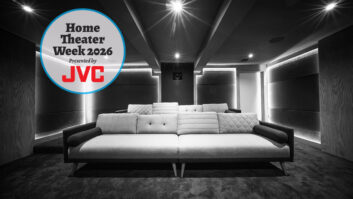
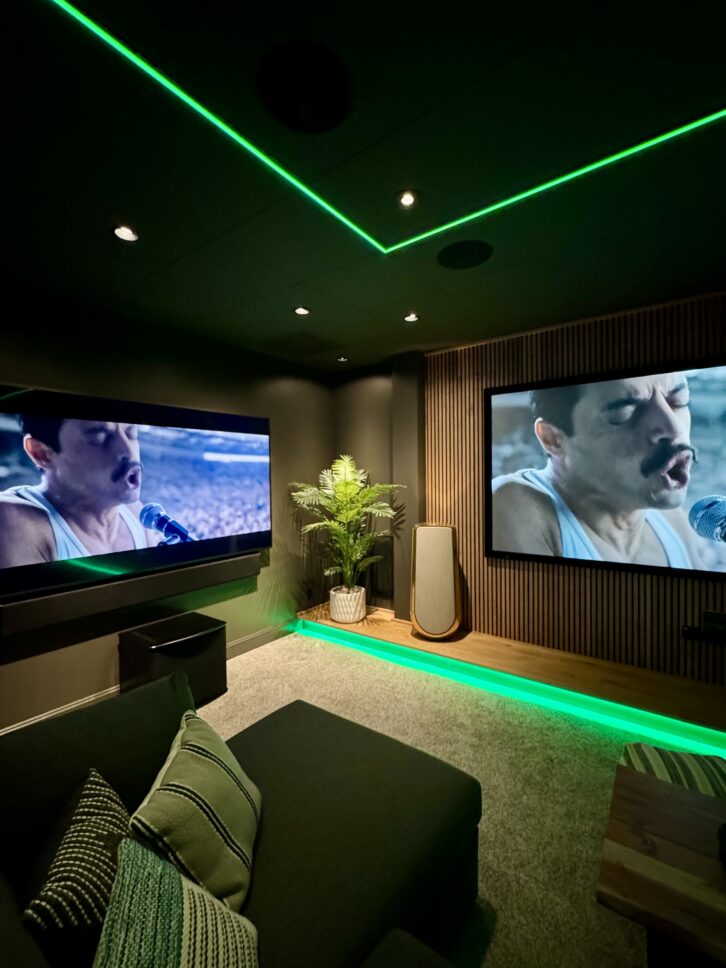
It’s not just clients getting a technological facelift — SoundVision recently renovated its own media room space so that it can better demonstrate today’s technology, converting its home theater into a media room environment.
“We wanted to show more of that media room design,” says Simpson. “With today’s projectors and the ambient-light-rejecting screens we have — combined with lighting control and automated window coverings — we can create that media room experience in an open-concept space.”
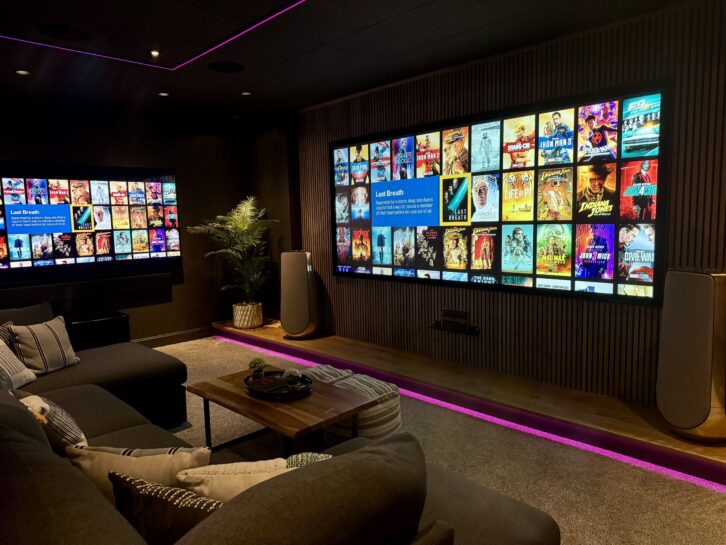
The previous room had two display systems: one was a 98-inch TV with a simple 5.1-channel audio setup from Theory, and the other featured a drop-down projection screen that would come down in front of the TV and be used in conjunction with an Origin Acoustics Marquee Dolby Atmos sound system. There were Lutron motorized drapery tracks along the left and right walls.
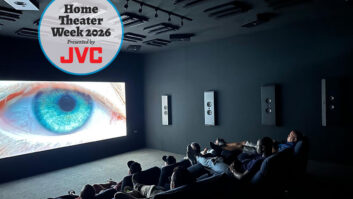
“That was successful and suitable for what we were doing six years ago, and I wanted to change it,” Simpson explains. “We were doing way more 2.35:1 screens, and I wanted to show a system that was completely out of sight and get into more of the organic, wood-type acoustic treatments that are popular now. We redesigned the entire space. We got rid of the TV completely and decided to solely focus on a big 2.35 screen with a JVC DLA-NZ800 projector tucked in a niche in the back of the room so it’s not hanging from the ceiling. All the speakers, which are still Marquees, are concealed behind the screen and walls and provide Dolby Atmos sound.
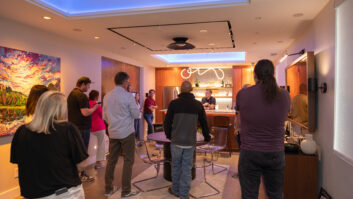
More than just a technology update, the experience center now provides a stronger representation of the type of design and integration work that SoundVision regularly provides. “Our layout here is a day in the life of technology,” says Simpson. “We don’t have walls of TVs and speakers, but the clients experience technology from the moment they walk in whether they realize it or not because of our concealed projection system, hidden speakers, and design-centric architectural acoustic treatments.
“As a company, we have fully embraced lighting, and so we have added lighting design in that room with various layers of recessed lighting for different purposes. We added in DMX-controlled linear lighting, so we’ve got a full RGB spectrum along the bottom edge of the stage and in the cove section of the ceiling. We can now show full tunable and RGB lighting in there. We also feature Lutron’s Rania and Lumaris downlights.”
The Red Room
The revised experience center played a part in a recent home theater retrofit completed by SoundVision. The new client had just moved into an existing house in a cul-de-sac where SoundVision was working next door. The homeowner saw the van in their neighbor’s driveway and asked them to check out her existing home theater, which she was not enjoying.
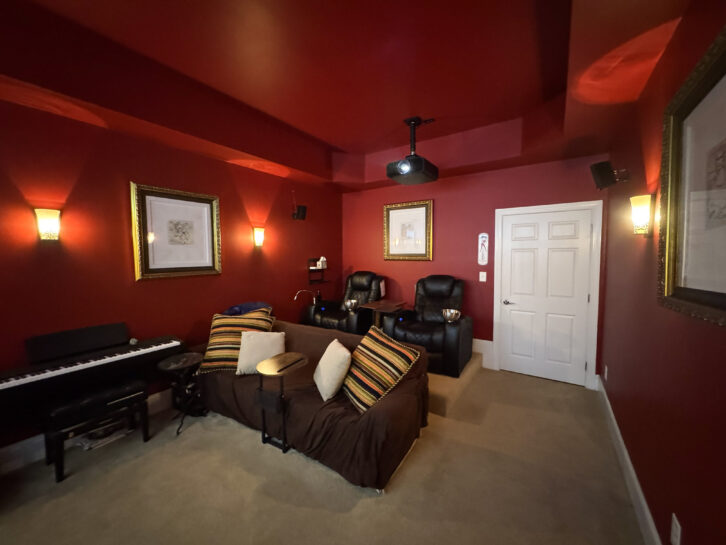
“She doesn’t know much about technology at all, but she does know that she has a flatscreen TV in her living room that looks great, but she also has a media room that looks poor when she watches the same shows,” Simpson remembers. “We went to the house and did a size survey, then had her visit our experience center. There, she started learning about 16:9 versus 2.35:1 and ambient light rejection. She quickly realized that the video quality between what she has and what she could have is like night and day.
“We upgraded her projector to a JVC DLA-NZ500, which is the little brother of the one we have in the experience center, and we put a Stewart Filmscreen 2.35 screen on the wall. She did not want us to change the audio system, but we did replace her subwoofer once we found out it was bad. For control, we installed a new user interface with a Control4 remote.
“She’s one of our most raving clients right now. We spent a day working in her theater and dialing it in. We set some custom aspect ratios because the shows she watches are either 16:9 or 2.35:1. So, we set in some recallable aspect ratios, and she and her husband absolutely love it.”
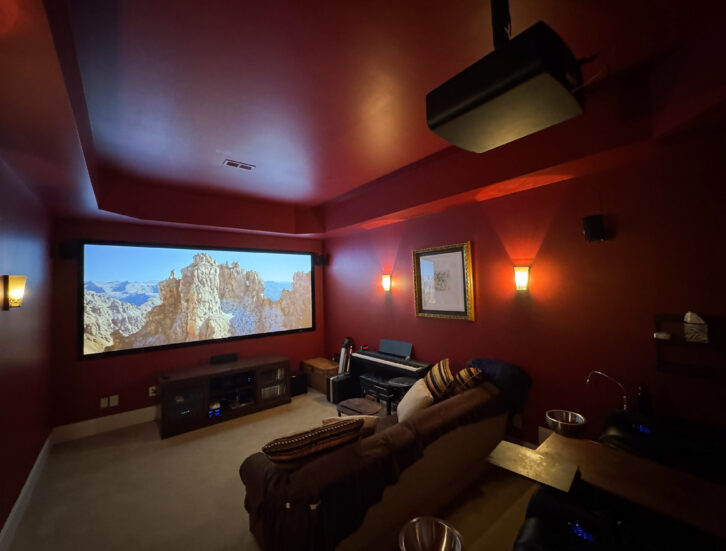
It was a fairly simple job for the SoundVision team, but one part did give Simpson pause. “The room was painted a very interesting shade of deep red,” he says, “and they no longer have access to that paint. I’m sure a qualified painter could do a mixture that was pretty close, but not exact. When we did the initial site survey, I told them that we may have an issue because this is more than just projector and screen.
“They had a Roku, and we made sure that the interconnect cable between the two is of high quality. We weren’t convinced that we were going to be able to use the HDMI cable that was in place. So, I had prepared the clients in the event we had to cut open an access hole or two to fish wire. I came up with the idea that, if that did happen, we should consider patching the hole and repainting the ceiling a darker color, but not red; maybe in the dark gray family. As luck would have it, our technicians are amazing, and the team that did that job did have to retrofit a wire, but were able to do it without any holes being cut at all.”
Want More Than Need
Technology does change quickly, but it has also become more durable, and SoundVision finds that its retrofit jobs do not come to fix a broken system, but more often to make it better.
“It’s become common knowledge that technology moves really fast,” says Simpson. “You certainly don’t want your projector to die, and it likely won’t — I could count on one hand the number of projectors we’ve had to replace because they died over the past seven years — but there’s going to be a compelling reason to upgrade it. People come to us saying they experienced new technology at a friend’s house or at a home they rented, and they know it is time for them to upgrade. And they’re upgrading out of want, not necessity.”
Not to mention the clients who complete jobs with their eyes on additional technology once they are ready. “I want to fix whatever the clients are concerned with, which builds trust,” concludes Simpson. “Then for any technology need they ever run into moving forward, they are going to pick up the phone and call us, and we’ll be able to cater to it.”
For more information, visit www.svavnc.com.