Audio/video over IP has become easier than ever, which is fortunate because it has become more popular than ever.
“Clients don’t typically ask us for specific distribution technologies, but they are good at presenting problems that don’t lend themselves to traditional solutions,” says Jeff Galea, president/CEO, Boca Tech & Automation (BTA), an AVPro dealer. “Today, we live in a world where the TV or a local game box can be a source, but we still need shared or centralized sources for whole-house music, audio from video sources, or even a doorbell sounder.”
BTA designs solutions using AV over IP because of the significant benefits it brings in terms of deployment flexibility, performance, and overall reliability. “It enables us to share sources from multiple locations to multiple locations because we are no longer locked into a centralized equipment room,” he says. “It also decouples HDMI audio from video sources and gives us the ability to distribute it using Dante to any audio zone, even zones with no TV. In short, it’s a problem-solver for customer requests.”
At Just Add Power, CEO Ed Qualls says there is increased interest in AV over IP coming from the end user. “Savvy consumers are beginning to look at the various options in the market, choosing features for themselves rather than relying solely on the integrator for recommendations. Two of the most important points for the customer are ease of use in controlling their systems and audio integration.”
Every AV over IP system needs a switch and a control system. “We ensure that systems will work flawlessly by testing our devices with a wide variety of brands of each technology,” Qualls notes. “This makes certain that the configuration of the systems will quickly and easily integrate the components in a way that provides ultimate control and the highest quality performance.”
Customers generally want solutions, and very few care about how an integrator gets from point A to point B, says Michael Short, VP of residential marketing, Crestron. “Once we explain to a homeowner the benefits of an IP-based system, and then everything that Crestron DM NVX AV-over-IP is capable of from future-ready infrastructure with less cabling, scalability, low latency, flexibility, etc., they’ll likely ask for that system,” he says.
And, as with any network solution, a hardwired backbone provides the most reliable and efficient AV-over-IP system. “From there, the proper network design is absolutely vital,” Short adds. “The installation phase should ensure that the interaction among designer, installer, programmer, and end user is considered in all installation decisions. Make it easy to use, easy to troubleshoot, and easy to service.”
Always Be Showing
“At BTA, we’ve designed an R&D showroom that enables us to deep-dive into new technologies and to become experts before we deploy them to our customers,” Galea says. “There is much to learn when designing a 10G AVoIP infrastructure, but the value is significant. Once you get over the learning curve, it makes designing and estimating projects more intuitive and scalable. We finished several large deployments this year, including a mega-yacht with many endpoints as well as a residential project with video tiling. We modeled both in our lab before deployment, and that made the on-site installation go very smoothly. One huge benefit, which also improves reliability, is the complete elimination of analog audio wiring. On the mega-yacht, for example, this fact, along with using AVPro Edge MXnet 10G and AudioControl Director amplifiers with onboard Dante connectivity, enabled us to go from six full racks to three. As a result, fewer devices need power, UPS, and remote power reset. All of this translates to higher reliability.”
The AVPro Edge MXnet 10G platform is what BTA uses if it has access to install the required infrastructure, such as Cleerline Fiber or 10G copper. “In cases where we cannot get a 10G backbone in place, we use the AVPro Edge MXnet 1G, which works with conventional 1G cabling,” Galea says. “Key features vary between 1G and 10G, but high-speed switching and built-in endpoint control are common to both. For the flagship 10G system, we leverage both Tiling and Dante, using AVPro’s native HDMI audio extraction.

“I found that the AVPro MXnet enables us to design and estimate systems quicker while exceeding the performance expectations of our clients; switching speeds are so fast, it’s actually amusing. The initial learning curve is reduced by excellent support from AVPro. For our first few projects, we sent our system designs to their engineers to verify bandwidth assumptions and sanity-check details like switch stacking and CBOX requirements. They are always quick to respond and have proven to be great partners over the years.”
Qualls says Just Add Power’s MaxColor line, with its 4K60 resolution and full color range, is chosen most often for installs where precise video is needed. “These include luxury residential, high-end hospitality venues, and science and healthcare settings,” he states. “Our Ultra product line, with its 4K resolution and lower price point, is still extremely popular for bars and restaurants, corporate settings, and higher education. Because of our strong audio performance, we are seeing more of our products installed in live venues such as houses of worship, theaters, and amusement/theme parks to create exciting guest experiences that combine AV over IP with dynamic soundscapes.”
Recently, Crestron introduced some new solutions, such as its DM-NVX-384, an encoder/decoder that’s scalable, flexible, efficient, and secure. As described on the company blog, it is “packed with features, including USB-C connectivity, multi-input switching, 5K support, and much more. The Multiview feature allows for the distribution of content from multiple sources so the user can view each image on a single display in a variety of fixed compositions.”
Click here to see the latest AV over IP news and new product information.
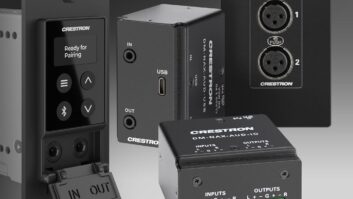
Short says it’s important to note that when you deliver video content to an endpoint, there’s an audio component there, too. “That audio can provide the soundtrack for the images, of course, but the same network can also be the foundation for standalone audio, and we’ve taken the knowledge we’ve gained from DM NVX AV-over-IP, combined it with the work that our audio team has done, and delivered the DM NAX audio-over-IP solution.”
Crestron’s senior product manager of AV solutions, Dustin Plumb, commenting on the company blog, says that “in traditional video-centric AV systems, audio followed video to a display and then got ‘broken out’ to a small audio system that could include a processor and audio amplifier. Today, audio from nearly any source can be encoded to a DM NAX, Dante, or other AoIP protocol and freely routed between devices on the network. Network audio devices handle signal routing and processing and can be remotely configured, managed, monitored, and controlled. DM NAX technology leverages all the advantages of network audio architecture in a comprehensive ecosystem of audio products.”
“AV over IP is a fantastic solution for the smart home, as more systems and devices become part of the home network, which is itself becoming more robust and efficient,” Short concludes. “Everything from switching to cabling requires less ‘stuff.’ That’s especially important, for example, in marine installations, where space is especially limited.”