There’s a consistent aesthetic across the lobbies and living rooms of Orange County, California, elites: clean sightlines, warm lighting, custom millwork, and screens everywhere. Offices and estates both feature curated video environments: ribbons of displays running marketing content, video walls anchoring lobbies, and projections spilling across backyard water features after dark. In the OC, many high-net-worth clients consider their workspace an extension of their personal brand, and their home an extension of their workspace. The AV experience has to be seamless across both: invisible when it should be and spectacular when it counts.
Keith Margeson, owner of Advantage Security Plus, is a Buffalo, New York, transplant who has made himself indispensable in these elite circles. Margeson spent decades doing end-to-end electronics work on the East Coast. He built Advantage Security Plus around security and cameras: reliable, recurring-revenue work. His experience with end-to-end AV solutions, however, proved to be a differentiating edge that led to referral after referral.
I sat down with Margeson recently to trace that journey from security integrator to trusted AV partner for a network of ultra-high-end clients who can’t stop trying to one-up each other.
LINDSEY CORBIN: Tell me about Advantage Security Plus. How did the business take its current shape?
KEITH MARGESON: I came out from Buffalo in 2007 for a job opportunity, and then the 2008 recession happened and that opportunity imploded. At that point, starting a company was actually easier than shopping my resume around, so that’s exactly what I did.
I focused on security and cameras because that creates automatic recurring monthly revenue; that’s always been the spine of the business. But earlier in my career, I had learned every aspect of low-voltage integration, and that gave my new company an edge. When we go into a Domino’s or a Burger King, we don’t just do the security system. We hang the TVs, the menu boards, we handle the network, the rack, the credit card machines, access control — anything low-voltage. The “plus” in Advantage Security Plus was always meant to signal that.
Related: What you need to know about pursuing commercial work
That capability made us the contractor’s favorite call. It’s not unusual on a commercial build to have seven different subcontractors managing different pieces of the low-voltage scope: somebody does AV, somebody does security, somebody does cameras, somebody hooks up the network. Contractors give us repeat business because with us, it’s one phone call.
You first connected with Vanco to spec a commercial project for a financial advisory firm, Guardian. What was that client looking for?
Guardian is a financial services firm offering life insurance tools and wealth management for high-net-worth clients. They were dropping $2.5 million on a full office remodel, with an AV budget around $225,000. Guardian was looking for total brand immersion: Everywhere you walk in that office, you’re seeing their commercial, their culture, videos of their top producers at a resort in the Dominican Republic, fancy cars, the lifestyle they’re offering to build for their clients. This branded content runs constantly.
They had a five-high vertical video wall in the front entrance, a seven-wide horizontal ribbon running across another wall, schedule boards, a welcome display in the manager’s office, and then roughly 50 additional screens throughout the space. Most of the displays are 65-inch Samsung Pro models, with three 85-inch screens in key spots. It all runs on one system: Vanco’s EVO-IP.
EVO-IP supported everything Guardian needed on a single platform: multiple video walls, schedule displays, and 50 distributed screens, all managed from a simple web interface. But what really sold me was the tech support conversation before I committed. I asked the rep directly: Will your team help me if I’m in the middle of an installation and I’m stuck? Will they get on the phone and walk me through programming? He told me they’d have someone standing by when I was ready to install. That was the sale, right there. I was moving forward with a product I’d never used on a project of that scale, because I knew I had that backstop.
I understand that the Guardian project led directly to a residential project for the firm’s principal. What was he looking for at home?
The project owner wanted me to come do his own place, a $7.5 million estate. He wanted an intercom that rings 12 locations, including the pool house, and lets you buzz someone in at the front gate from anywhere on the property; displays along the hall that would play Guardian-branded content during parties; outdoor audio across a U-shaped patio with six pairs of speakers; projection above the pool to bring the Guardian content outside; plus three home theater rooms and a game room.
In both cases — the Guardian offices and his residence — would it be fair to say the project goals really revolved around the client’s brand?
One hundred percent. With Guardian, the brand identity of the company runs everywhere, all the time. They’re not allowed to change it unless they’re doing a presentation. The whole suite remodel was about making an impression the moment you walk in the door.
The client’s home is an extension of that. He is the business. The same content that runs in the office is running in his hallway and over the pool. The home is a venue, and the venue is always performing.
How did the overlap in goals across those two projects affect your approach to system design?
It simplified everything, actually. I knew EVO-IP well from Guardian: I’d burned in all the edge cases, figured out the content formats for each wall, and worked through the audio routing. The residential install was straightforward by comparison. I already knew what to spec, how to wire it, and what the product could do. Using the same core platform across both environments means I can execute consistently, I can service it confidently, and the client gets a consistent experience whether they’re in their office or their game room. They’re not learning a new interface at home. That matters to these clients. They want seamlessness.
Having a short list of go-to products that perform well in both residential and commercial contexts means less design time, fewer surprises on-site, and better margins as you repeat the work. I’m not reinventing the wheel on every job.
Did your work for Guardian and its principal lead to other clients?
It did, and the pipeline ran in both directions: residential and commercial. His clients are all high-net-worth individuals, and once they saw what I’d done for him, they started calling. One of the most active clients I have now from that circle is a dentist who had me do his home. Now, I’m finishing his fourth dental office build in the past two months. Same basic concept: He wants the offices to reflect the brand, Apex Dental. When you walk into one of his offices, there are TVs with branded content everywhere. The presentation, the clean installation, and the experience all have to exemplify the concept of “apex” — being the best. This whole circle takes the idea of personal branding extremely seriously.
So, there was a certain amount of “keeping up with the Joneses” happening across this client network.
That’s exactly right, and it fed on itself. So when one of these guys gets a video wall in the game room, the next phone call I get is from his friend who wants to know what that was and whether he can have one. And then that client adds something the first one didn’t think of, some creative wrinkle, and now the first one wants to upgrade. It becomes a self-reinforcing cycle. The competition isn’t just about having the same thing as your peers; it’s about having a better version, or being the first one with the next thing. That’s been really good for the business.
What were some of the most interesting design challenges to come out of that cycle?
I did a fantasy football draft room that really pushed things technically. A client’s son wanted to use their game room to host his fantasy league’s annual draft. Sounds like a simple ask until you unpack what that actually requires.
Also by Lindsey Corbin: Mastering the Mid-Market
For the draft, they wanted at least two sources running games, combine footage or stats, plus the draft board itself, all visible at full size. I spent a serious amount of time researching how to meet the requirement for three independent sources on the same video wall, at the same time. A lot of platforms will do picture-in-picture or let you run two sources on a wall. EVO-IP let me configure three sources on one wall simultaneously out of the box without the need for an additional content management layer.
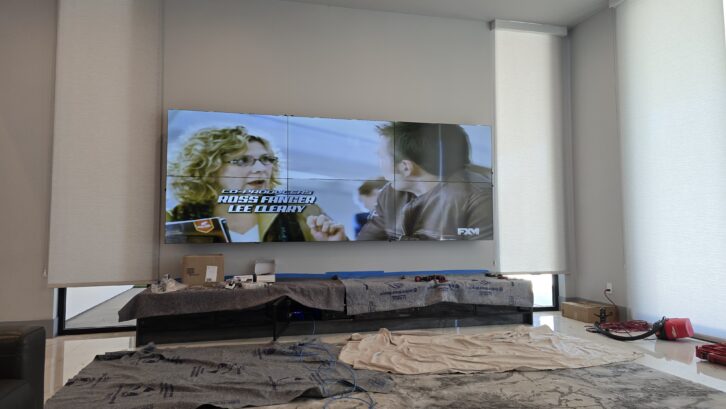
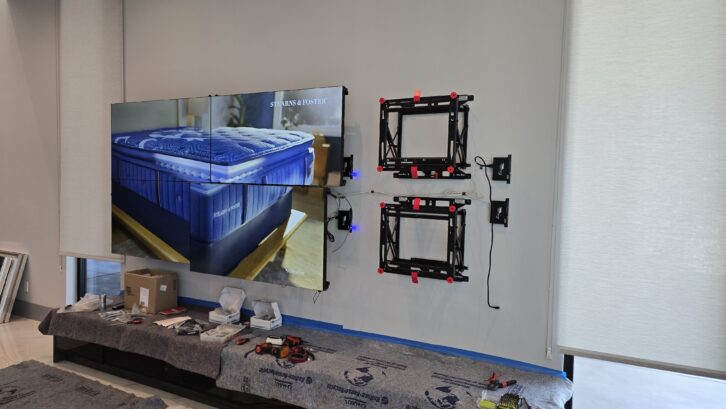
The game room has a 2×3 video wall: six 42-inch LG displays in that nearly bezel-free form factor, with three labeled HDMI inputs in the cabinet. Apple TVs handle the sports content, and there’s an HDMI input for a laptop to run the draft board. When it’s time for the draft, they just plug and play.
The wall itself was also a revelation visually. I’d been nervous a 2×3 layout would look too wide, too distorted. It looks like a movie theater. I used metal flashing cut and bent to match the TV profile and create a seamless border around the entire wall. Nothing’s exposed, nothing looks pieced together. It looks like it was built that way.
As you’ve taken on more projects for high-net-worth clients in this network, what have your biggest surprises or lessons learned been?
Even with elite clients, simplicity wins. These days, you can build a great experience even without a dedicated control system layer. Apple, Sonos, Vanco…these ecosystems talk to each other. The client controls it from their phone. Done.
The other lesson is that these clients talk to each other constantly. If you do right by one of them — if you’re honest about where to spend money and where not to, if you answer the phone, if the system actually works — you will never run out of referrals. For example, the original principal at Guardian left the firm eventually. He called me a week ago and told me to be ready. He’s starting over somewhere new, and he wants the whole thing done again. That’s the kind of client relationship that makes everything else possible.
What’s next for Advantage Security Plus? Will you lean further into residential going forward?
I don’t think the answer is leaning one way or the other. The clients I serve don’t make a hard distinction between their office and their home. They expect the same quality, reliability, and experience everywhere they go. If I only did residential, I’d miss the commercial projects that create those relationships. If I only did commercial, I’d be handing off some of the most interesting and lucrative work to somebody else.
The boundaries between resi and commercial are already blurry at this level of the market. I think they’re only going to get blurrier. The advantage goes to the integrator who doesn’t have to switch gears; who can design a system for a financial advisory firm and its founder’s estate and deliver a consistent experience across both. That’s what we do. And I think there’s a lot more of that work out there.
For more information, visit advantagesecurityplus.net.